 Busirank Team
Introduction
Distributed marketing breaks in predictable places. Headquarters creates the plan, local teams execute it inconsistently, problems surface late, and the same work repeats every week across every location . A regional manager updates last year’s flyer with an outdated logo. A franchisee hires a freelancer who recreates the brand from an old asset. A local promotion goes live before anyone checks whether the required legal copy is included . None of these failures come from bad intent. They come from operational freedom without structural safeguards .
The fix is not more oversight. It is standardization with automation at the layer where variation is not valuable. Local marketing workflow automation is the discipline of defining what every location must do, what every location may adapt, and which steps the system executes without asking anyone. Done well, it replaces the two bad options—a slow central bottleneck and a fast but chaotic free-for-all—with a third: local teams moving quickly inside guardrails they cannot accidentally break .
This guide covers the task inventory, the decision-rights framework, the template and approval architecture, and the tooling that turns standardization from a policy document into an operating system.
Why Distributed Teams Diverge (and Why Training Does Not Fix It)
The conventional response to inconsistency is training and documentation. Both help, and neither solves the problem, because the divergence is structural, not educational. When a location needs a grand-opening flyer by Friday and the central team is unavailable, someone will use whatever is fastest . The fastest option is usually the old file, the freelancer’s interpretation, or the unapproved layout.
The data behind this is stark: 95% of companies have brand guidelines, but only 25% enforce them . A guideline document that lives in a shared drive and depends on someone remembering to open it is not a control. It is a suggestion. The same pattern appears in franchise marketing, where corporate is accountable for one brand while dozens of operators need content at local speed—and the gap between central control and local execution is where every inconsistency is born .
The predictable failures are specific enough to name. Content governance failures—the wrong logo, a stale address, an unapproved layout—are the ones a platform can actually fix. Service consistency failures belong to operations. Review, listing, and reputation failures belong to a local-presence owner. Legal and compliance failures belong to legal, guided by the franchise agreement . Treating all four as one problem, owned by one team, overpromises and leaves locations without a clear person to ask.
Step 1: Build the Task Inventory Before You Automate Anything
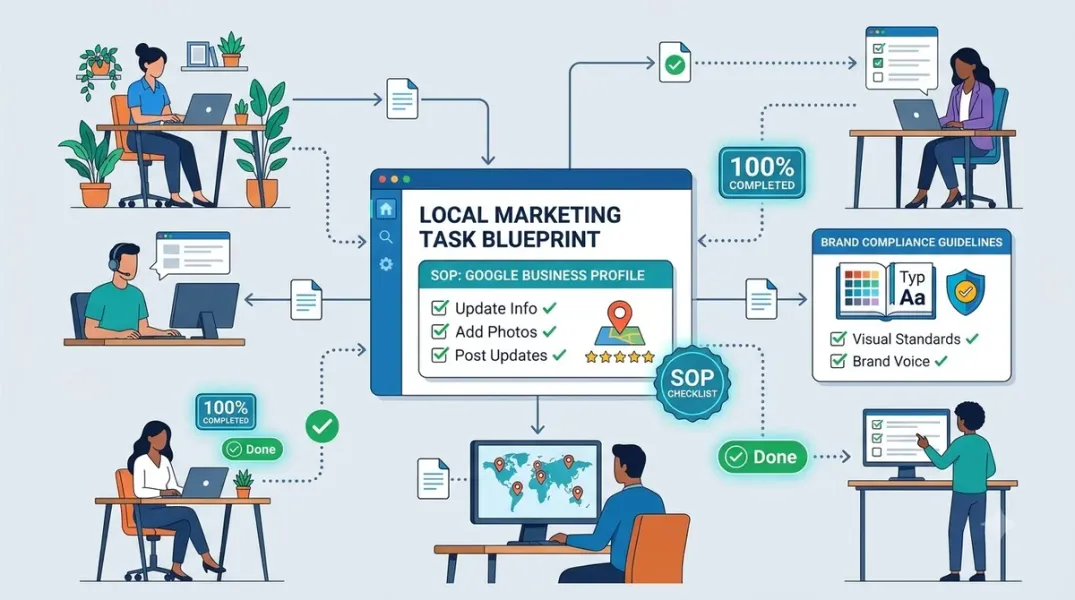
Standardization starts with a complete, written list of every recurring local marketing task, with a named owner and a cadence attached to each. A franchise marketing checklist is exactly this: the standing list of local tasks the unit completes, in order, with a named owner and a date on each one .
The task inventory for a typical distributed local marketing operation covers six families:
Profile and listings maintenance — hours (including holiday hours), categories, services, attributes, address and phone accuracy, photo refreshes, duplicate monitoring.
Review management — review requests, response to positive and negative reviews, escalation of sensitive reviews, Q&A monitoring.
Content publishing — Google Business Profile posts, local social posts, campaign creative deployment, seasonal offers.
Local pages and website — location page accuracy, service and staff updates, local landing page content.
Paid and directory presence — local offer input, directory consistency, budget and service-area confirmation.
Reporting — lead-quality feedback, sales reconciliation, and adoption confirmation.
The inventory should record, for each task, whether it is corporate-owned, local-owned, or shared—and this is where the second step begins.
Step 2: Define Decision Rights Explicitly
The single most important document in a distributed marketing operation is not the brand guidelines. It is the decision-rights table: the written answer to what corporate controls, what the location controls, and what requires approval.
The division that works is consistent across the 2026 playbooks. Corporate owns the reusable system: brand rules, approved creative, website templates, tracking standards, vendor requirements, shared reporting, and the campaign menu. The location owns current local truth: hours, service area, capacity, community context, review follow-up, and the operational response after a lead arrives . Corporate should not hand an operator a blank ad account and a logo folder; the operator should not wait for headquarters to discover that the location closed early or changed its phone routing .
The practical format is a three-column table applied to every task in the inventory: Locked (corporate-only, no local edit), Editable (local can change within approved parameters), and Approval (local can draft, corporate must approve before publish). The table answers the question every local marketer actually asks under deadline pressure: can I change this, and if not, who do I ask?
Step 3: Shift Enforcement Into the Template
The insight that separates mature operations from struggling ones is that review workflows alone are reactive. By the time a review catches a problem, the post has already gone out . Enforcement has to happen at the point of creation, not after it.
The 2026 template architecture that does this has three components.
Protected structures. Design elements can be grouped into structures that cannot be separated or moved accidentally. Logos, legal disclaimers, and layout zones are locked from editing while remaining fully visible. Local teams still personalize content; the brand structure stays intact .
Controlled image zones. Smart Image Frames define exactly where local imagery appears, preserving the approved layout structure while allowing the location to supply its own photo .
Dynamic fields. Graphic elements inside templates are tagged with dynamic fields—phone number, address, location name, offer text. When headquarters schedules a post, the platform renders a unique localized asset for each location automatically, with no manual duplication and no per-location editing. The critical business information appears directly on the creative, not just in caption copy that local teams often skip or forget to update .
The result is that the approved path becomes faster than improvising. A location that can generate a correctly branded, correctly localized asset in two minutes has no reason to open last year’s file.
Step 4: Route Approvals by Risk, Not Uniformly
A standardization program dies when every piece of content requires headquarters approval. The queue backs up, local teams route around it, and the guardrails lose credibility. The workflow that survives is tiered by risk.
The operating model that holds up: routine content auto-publishes or one-click approves; high-risk content routes to approval automatically; and HQ reviews before anything goes live only for the categories that carry legal, pricing, or reputational exposure . In practice, that means seasonal updates and approved campaign creative move fast, while new claims, pricing terms, and regulated copy sit in a review queue.
The approval mechanism itself should be assigned, not just visible. Modern platforms route proposed actions into an approvals queue, allow assignment to specific team members, and record an audit trail showing what was done and why. In one documented deployment, 94% of the actions proposed by the agent were approved without edits—which is the signal that the guardrails and the brand voice are configured well enough that the approval step is a glance, not a rewrite .
Step 5: Automate the Recurring Work, Keep Humans on the Judgment
The automation layer is where standardization stops costing time and starts saving it. The task families that are safe to automate are the ones that are repetitive, rule-bound, and reversible.
Scheduled agent actions. Autonomous local marketing agents now execute tasks across listings, reviews, social posts, SEO audits, and local visibility through scheduled playbooks—local post generation, SEO audits, and review response drafting—with human review retained for proposed actions . This shifts the model from software access to task execution: the system does the work, and the team reviews rather than performs.
Connected AI workflows. The friction in AI tools is rarely generation—it is the handoff: generate, copy, switch screens, paste, continue. That sequence multiplies across every location in a network running it daily. The 2026 fix is an end-to-end workflow where generation, editing, and execution happen in a single view, removing the step that quietly caused teams to skip the AI feature entirely .
Natural-language operations. Headquarters teams can now query live network performance, create posts, respond to reviews, build automated workflows, and pull data into external tools in natural language, which collapses the training curve for new location managers and reduces the number of places a task can stall.
The measured effect is substantial: agentic workflows reduce manual task execution time by an estimated 60–80% in repetitive deliverables such as Google Business Profile post scheduling . That is the hours that should be reinvested in the local judgment that cannot be automated—the relationship with the customer, the community context, the response to a sensitive review.
The Operating Rhythm and the Metrics That Prove Standardization Works
Standardization is not a one-time configuration. It is a rhythm with three cadences.
Weekly: review the approvals queue and the exceptions log. Every exception is a signal—either the template is missing a local need, or the local team is bypassing the approved path, and the two require different fixes.
Monthly: audit adoption and freshness. Which locations are using the approved templates, which are publishing stale content, and which have not posted at all? A performance leaderboard that shows each location side by side makes the laggards visible without a central audit .
Quarterly: review the decision-rights table against what actually happened. If a “locked” element was edited, the lock failed. If an “editable” element never varied, the local teams either do not know they can edit it or the template is too rigid.
The metrics that matter are adoption, freshness, response time, and exception volume—not the number of templates created. A network where every location publishes fresh, on-brand content within the response-time target is standardized. A network with an elegant template library and three locations using it is not.
The Tools That Support This Workflow
The market has consolidated around distributed marketing platforms that combine brand control, template customization, approvals, and reporting.
PromoRepublic is built for franchise and multi-location brands with template governance, dynamic fields that render per-location assets at scheduling time, and AI-assisted review responses with an end-to-end workflow. It is trusted by 110+ franchise networks and 25,000+ locations .
Constant Contact Teams is a command center for multi-location organizations, with a single hub for organization-wide performance, roll-up reporting, a performance leaderboard, and AI insights that surface health trends and pending approvals across all workspaces. Centralized governance—brand controls, approval workflows, locked templates—lets local teams execute independently within approved guardrails. One customer reported cutting reporting from half a day to under an hour .
Synup’s Sydekick is an autonomous agent for local marketing tasks, with scheduled playbooks for post generation, SEO audits, and review response drafting, an approvals queue with audit trails, and 94% of proposed actions approved without edits. Pricing is shifting to usage-based credits tied to actions completed, which aligns cost with work performed rather than seats .
Marq approaches the problem from brand governance: locked templates with editable zones, defined approval paths, and a framework that makes the approved path faster than submitting every request or improvising off-brand content. SOCi runs an agentic workforce for localized marketing at enterprise scale, executing more than 27 million localized tasks a year and eliminating over 5 million hours of manual marketing work .
For a smaller operation, Sked Social offers HQ brand kits, approval chains, and franchise-friendly approvals where store managers post in minutes and reporting rolls up across the network .
Conclusion
Standardizing local marketing tasks across a distributed team is not a brand guidelines project. It is an operating design project, and it has five parts: a complete task inventory with owners and cadences, a written decision-rights table that answers locked/editable/approval for every task, template architecture that enforces the brand at the point of creation rather than in review, risk-tiered approvals that let routine content move at local speed, and automation for the repetitive work—measured by adoption and freshness rather than by the number of templates built.
The evidence supports the effort. Agentic workflows cut repetitive task time by 60–80% . Approval queues with well-configured guardrails see 94% of proposed actions approved without edits . Networks that centralize governance while giving local teams controlled customization report the same outcome in different words: consistency without the bottleneck, and local speed without the brand drift . The organizations that get this right do not choose between control and speed. They build a system where the fastest path is also the approved one.
Call to Action
Build the decision-rights table before you buy a platform. List every recurring local marketing task and mark each one Locked, Editable, or Approval. Assign a named owner to every row. Then identify the three tasks that consume the most local team time and check whether the template or workflow enforces the brand at the point of creation—or whether it depends on someone remembering a guideline. If it depends on memory, fix the template first. If you are evaluating tools, shortlist by the features that match your gap: PromoRepublic or Marq for template governance and locked zones, Constant Contact Teams for roll-up visibility and a performance leaderboard, Synup Sydekick for autonomous task execution with an approvals queue. Run one month of weekly exception reviews before expanding automation, and use the exception log to decide which guardrails to tighten and which to loosen.
FAQs
What is local marketing workflow automation?It is the use of software to execute and enforce recurring local marketing tasks—profile updates, review responses, post publishing, listing corrections, and reporting—across multiple locations. It replaces manual, per-location execution with scheduled, rule-based actions that local teams review or approve, and it enforces brand standards at the point of creation rather than in after-the-fact review.
How do I standardize local marketing across a distributed team?Five steps: build a task inventory with a named owner and cadence for every recurring task; write a decision-rights table marking each task Locked, Editable, or Approval; move enforcement into locked templates with editable zones and dynamic fields; route approvals by risk so routine content moves fast; and automate the repetitive work while keeping humans on sensitive judgments.
What should corporate control versus what should local teams control?Corporate owns the reusable system: brand rules, approved creative, website templates, tracking standards, vendor requirements, shared reporting, and campaign menus. Local teams own current local truth: hours, service area, capacity, community context, review follow-up, and the operational response after a lead arrives. The failure mode is handing a location a blank canvas or making it wait for headquarters to discover a change.
How do I stop local teams from going off-brand without slowing them down?Make the approved path faster than improvising. Lock logos, legal text, and layout zones in templates; define controlled image zones for local photos; use dynamic fields to auto-generate per-location assets at scheduling time; and route only high-risk content to approval. When a correctly branded asset takes two minutes to generate, there is no incentive to open last year’s file.
What should be automated versus kept manual in local marketing?Automate repetitive, rule-bound, reversible tasks: scheduled post generation, review response drafting, SEO audits, listing monitoring, and reporting rollups. Keep humans on judgment-heavy tasks: sensitive review responses, legal or pricing claims, new campaign concepts, and community-specific decisions. The measured automation dividend is 60–80% time reduction on repetitive deliverables, which is the hours to reinvest in local judgment.
Which tools support standardized local marketing across distributed teams?PromoRepublic (template governance, dynamic fields, AI review workflows), Constant Contact Teams (hub-and-workspace governance, roll-up reporting, performance leaderboard), Synup Sydekick (autonomous task execution with approvals queue and audit trail), Marq (locked templates, editable zones, brand governance), and SOCi (agentic workforce at enterprise scale) are the leading platforms in 2026. For smaller networks, Sked Social provides brand kits, approval chains, and franchise-friendly approvals.
How do I measure whether standardization is working?Track four metrics: adoption (share of locations using approved templates), freshness (share of locations with current content), response time (review and lead response against target), and exception volume (how often the approved path is bypassed). A quarterly review of the decision-rights table against actual behavior reveals which locks are failing and which editable zones are too rigid.
Internal & External Links
Internal links (to other posts in this series):
- How to Manage Google Business Profiles for Multiple Clients Without Account Chaos (previous post)
- How to Set Up Team Permissions for Secure Google Business Profile Management (next in series)
- How to Create a Consistent AI Brand Voice for Every Business Location
- How to Set Up Review Approval Workflows for Your Marketing Team
- How to Publish Google Posts Across Multiple Business Locations Efficiently
- How to Create White-Label Local SEO Reports for Your Agency Clients
- Best Google Business Profile Management Software for Small Businesses in 2026
External links (sources referenced in this article):
- PromoRepublic — H1 2026 Product Updates Defining Local Marketing: https://promorepublic.com/en/blog/h1-2026-product-updates-defining-local-marketing-in-2026/
- Synup / IT Brief India — Synup launches Sydekick AI agent for local marketing: https://itbrief.in/story/synup-launches-sydekick-ai-agent-for-local-marketing
- Constant Contact — Constant Contact Teams: A Command Center for Multi-Location and Multi-Team Marketing: https://news.constantcontact.com/2026-10-06-Constant-Contact-Teams-A-Command-Center-for-Multi-Location-and-Multi-Team-Marketing
- Marq — Distributed Marketing Platform in 2026: What It Is, Benefits & More: https://www.marq.com/blog/distributed-marketing-platform/
- Marq — Franchise brand management: How to scale consistency and ensure compliance across locations: https://www.marq.com/blog/franchise-brand-management/
- Anderson Collaborative — Local Marketing for Franchisees: A Practical Playbook: https://www.andersoncollaborative.com/knowledge-base/local-marketing-for-franchisees-playbook/
- V Digital Services — Essential Franchise Marketing Checklist for Owners to Drive Success: https://www.vdigitalservices.com
- PromoRepublic — Local Marketing for Franchise & Multi-Location Brands: https://promorepublic.com
- Sked Social — Sked for multi-location brands: central brand, local run: https://skedsocial.com
- SOCi — SOCi Surpasses 400,000 Deployed Genius Agents™: https://www.tmcnet.com
- Zenodo — Agentic AI Workflows for Marketing Automation at Scale (March 2026): https://www.zenodo.org
- Google for Developers — Manage locations at scale: https://developers.google.cn/my-business/content/manage-locations
How to Set Up Team Permissions for Secure Google Business Profile Management
Grow Your Google Maps Ranking on Autopilot
Stop spending hours every week manually replying to customer reviews and writing Google posts. Busirank automates your Google Business Profile to boost your local SEO rankings and turn searchers into paying clients.
 Busirank Team