 Busirank Team
Introduction
A franchise is not a multi-location business with a different logo. A multi-location business has one owner and one set of incentives. A franchise has two parties with legitimate but different interests in the same public listing—the franchisor owns the brand, and the franchisee owns the storefront. Google’s Business Profile system has no concept of a franchise agreement. It recognizes account ownership and manager permissions, full stop. Get that mismatch wrong, and the franchisor can lose control of a location’s public-facing reputation the moment a franchisee relationship goes bad.
The structural difficulty shows up in the content. A corporate chain can simply mandate what every location’s GBP shows. A franchise network cannot, not without risking real friction, because franchisees have a legitimate stake in their local presentation while HQ has a legitimate brand-protection interest of its own. Either HQ overreaches and the relationship sours, or HQ under-governs and each unit drifts into whatever name, category, and description someone locally decides looks best that month.
Franchise Google Business Profile management is the discipline of holding both interests at once. It is the job of keeping the fields that protect the brand—name, category, core description—under central control while leaving genuinely local decisions with the person running the unit. This guide covers the ownership architecture, the field-level permission model, the content system that prevents template drift, the review governance that scales, the suspension risks that threaten entire networks, and the measurement that replaces brand-level averages with per-location truth.
Why Franchise Content Governance Is Structurally Harder
The tactical work of local SEO is the same for a franchise as for any multi-location brand: accurate listings, good categories, reviews, local landing pages. What changes is who is allowed to do it. Corporate owns the brand, the franchisee owns the storefront, and rankings fail at the seam between the two. A regional manager changes a primary category because it sounds better. A new franchisee creates a second profile because they cannot get access to the first. A location moves two blocks and nobody updates the listing.
None of these are SEO mistakes in the usual sense. They are operational mistakes that produce SEO damage, and no amount of content fixes them. The failure patterns repeat across networks: templated cloning (location pages that differ only in the address block), data drift (phone numbers, categories, and hours diverging between the website, GBP, and directories over time), and rogue local edits (franchisees editing GBP fields without oversight, often with good intentions and poor SEO judgment).
The scale of the problem is documented. 68% of multi-location enterprise brands experience at least one unexpected Google Business Profile suspension each year due to automated compliance updates. Multi-location franchises lose up to 30% of their potential local search traffic due to preventable Google Maps errors. And 48% of franchise brands still leave local reputation management entirely to individual franchisees with no standardized response process—brand consistency that exists in the uniforms and the menu but breaks down the moment a customer posts a review.
The governance answer is not more control or more autonomy. It is precision about which parts of the profile need central oversight and which parts produce better outcomes when they stay with the local team.
Step 1: Corporate Must Own Every Listing—Franchisees Manage, Never Own
The most consequential decision in franchise GBP management is also the simplest: who owns the listing? The pattern that works is unambiguous: the franchisor builds every GBP listing, owns every listing, and retains owner-level credentials at the corporate level. The franchisee is set up as a manager—not an owner.
The reason is not control for its own sake. It is exit risk. When a franchisee exits the system—whether amicably or not—a listing they own becomes a listing the brand does not control. The former franchisee may leave it active, update it with incorrect information, or simply abandon it. Google does not resolve ownership disputes quickly. Reclaiming a listing through a trademark claim can take months, and during that period the brand’s presence in that market is wrong, stale, or missing.
The structure must be established proactively, not retroactively. If the network already has franchisee-owned listings, a remediation program should be built into the next franchise agreement renewal cycle. And the requirement belongs in the franchise agreement, not in a verbal request. Google has no field for “franchisor” or “franchise agreement,” and no process that lets a corporate team claim a listing by proving the business relationship. If a franchisee verified the listing under their own personal Google account and never granted the franchisor manager access, the franchisor has no direct way into that profile through Google alone. The fix has to happen contractually.
Review notifications follow ownership. Google Business Profile sends review notifications to the listing owner, not to the manager. If the franchisee is the owner, corporate never sees the review notification. If corporate is the owner, every review hits the corporate inbox—which is exactly where it needs to go for a brand-level response program.
Step 2: Build the Field-Level Permission Model
The ownership rule settles who holds the keys. The permission model settles which fields each party is allowed to touch. The most effective franchise GBP structures split every profile field between corporate and franchisee authority, with audited overrides.
Corporate controls the fields that protect the brand everywhere:
- Business name formatting — a trademark concern first and an SEO concern second. The acceptable format is “Franchise Brand — [Location]”; keyword-stuffed or reordered names risk suspension for the whole network.
- Primary and secondary categories — category changes move rankings immediately, and inconsistent categories across a network send conflicting signals to Google about what the brand is.
- Core business description — brand-standard language, with an approved local insert for neighborhood context; wholesale replacement breaks the consistency the entity depends on.
- Profile status monitoring — HQ needs visibility into every profile’s status, not just the flagrant cases a franchisee happens to report late.
Franchisees control the fields that genuinely change day to day:
- Hours and holiday hours — only the store knows when it is actually open, though the data should be submitted through a defined channel rather than edited independently.
- Local photos — the team, the store opening, the community event; brand-approved before uploading, but locally sourced.
- Local promotions and offers — neighborhood-specific marketing, submitted for approval and then published.
- Per-location contact details and service availability — the local truth that corporate cannot know from a distance.
Review replies are shared, with approval on sensitive cases — speed matters, tone risk is real.
The permission architecture in Google’s own system maps onto this model. HQ marketing holds Owner or Manager at the location-group level. Regional managers hold Manager access scoped to a region-specific location group. Franchisees hold Site Manager access scoped to their location only. The hierarchy gives each party the access their span of responsibility requires and no more.
Step 3: Separate the Non-Negotiables From the Local Slots
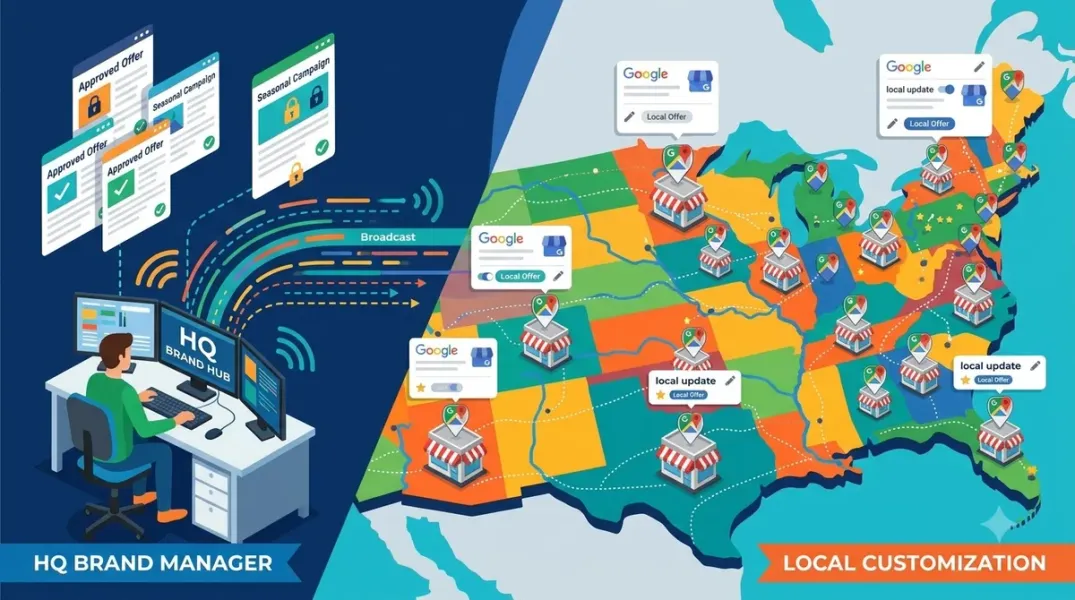
The content system is where governance becomes operational. The structure that works is a locked core with editable local fields—the same logic as a template with brand-controlled zones and franchisee-fillable slots.
The locked core: business name, categories, core description, required attributes, brand-standard service descriptions. These are the fields where a single local edit can damage the whole network’s entity clarity.
The editable local layer: a unique introductory paragraph written for that specific town or postcode, at least one photo of the actual premises or team, a named staff member or franchisee note, and one local element head office cannot mass-produce—a community tie-in, a local sponsorship, a local review.
The operational mechanism is a short brief given to each franchisee at onboarding and annually: the name of the nearest local landmark, one community event they have sponsored, one staff member’s name, and one genuine local testimonial. That brief is what fills the local slots without requiring the franchisee to write from scratch or the corporate team to write fifty unique pages.
Templated cloning is the failure mode to avoid. Google sees fifty thin, duplicate pages competing for the same rankings, and none of them wins. The September 2025 Spam Update explicitly targeted near-identical templated location pages. Every page needs a unique introductory paragraph, not a find-and-replace of brand copy. Every page should carry at least one local element the head office cannot mass-produce.
The content cadence follows the same split. Corporate schedules the monthly theme and the approved offer framework. The franchisee supplies the local detail and the local photo. Posts go out on a shared calendar, with the core message locked and the location-specific slot filled locally. The franchisee who feels like every field is dictated from corporate tends to disengage from the profile entirely; the one who owns the parts that are genuinely local usually keeps the profile more active.
Step 4: Govern Reviews Without Micromanaging Every Reply
A franchise brand operating across forty locations cannot realistically approve every review response before it goes live. The volume does not allow it, and consumer expectations do not either: 19% of consumers expect a same-day response and 32% expect one within 24 hours. But handing full control to individual franchisees produces brand voice drift, sensitive responses going out without a compliance check, and inconsistency that is often more damaging than the original review.
The answer is tiered escalation by risk, not uniform approval.
Routine positive and neutral reviews move through a faster, franchisee-led process within the approved framework—the local team knows the customer, the context, and the specific detail that makes a reply feel real rather than templated.
Sensitive reviews—discrimination allegations, safety incidents, food hygiene complaints, legal threats, staff misconduct, anything likely to attract media attention—route to a central escalation owner immediately. The public acknowledgment stays neutral; the substance moves to a private channel.
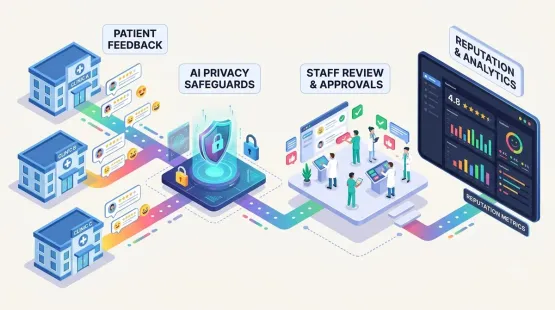
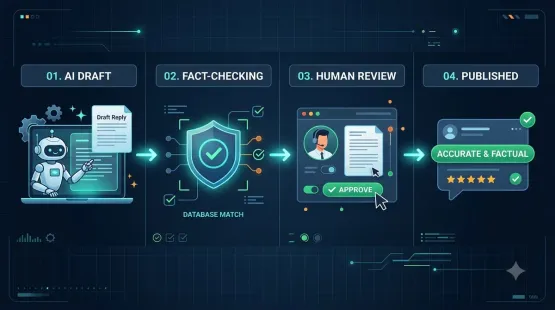
The tooling supports this directly. Yext’s Review Response Approvals create a review step between drafting and posting: a franchisee with suggestion-only permissions drafts a response, it enters an approval queue, and a corporate user with approval permissions approves or rejects it with a reason. SOCi’s franchise workflow keeps franchise partners approving all responses so the human stays in the loop while AI handles the drafting. The operating principle is framework, not script: central governance defines the tone guidelines, the approved language for sensitive topics, and the escalation rules; the local team supplies the specificity.
Step 5: Prevent the Suspension Risks That Threaten the Whole Network
A single suspended Google Business Profile is a bad month. Twelve suspended profiles across a franchise network is a crisis: every branch vanishes from Maps simultaneously, calls stop, and reinstatement drags for weeks while franchisees blame head office.
The triggers are documented and ranked. An analysis of suspension cases found address verification failures as the single largest category at roughly 42%, ahead of business name issues at 28% and review manipulation at 17%. Duplicate listings for the same physical address can trigger immediate profile suspensions across entire location groups, and even a duplicate with zero reviews can still trigger the spam-signal suspension risk.
The structural defenses are specific:
- One organization-owned Google account on the company domain as Primary Owner of every profile—never a marketer’s personal Gmail, never a franchisee’s.
- Bulk verification through a business group, with every location verified and deduplicated before optimization begins.
- Consistent NAP data held in a single source of truth, because mismatched details across directories erode Google’s confidence in the listing and demote it in the local pack.
- Profile Guard monitoring that alerts HQ when any location’s data is modified by Google, users, or competitors—catching unauthorized changes before they become suspensions.
- Annual category audits, because Google adds, modifies, and removes categories, and what was the best choice in 2022 may not be the best choice now.
Step 6: Measure Per Location, Not Per Brand
A franchise with 80 locations is running 80 local SEO campaigns that happen to share a logo. An average ranking across 80 locations tells you nothing about the twelve that are invisible. Network-level reporting is misleading by design.
The KPIs that belong on a per-location scorecard are the ones that connect content activity to local outcomes: GBP interactions (calls, direction requests, website clicks), review velocity (a location with 30 reviews receiving 2–3 new reviews monthly can outrank a location with 80 reviews and no recent activity), keyword rankings for the terms that drive local calls, local pack and geo-grid visibility, organic sessions per location (a benchmark of 200–600 per month at 6–12 months), and conversion rate per location landing page.
The measurement cadence is monthly reporting, quarterly review, with the location scorecard showing gap from network median rather than a raw ranking. A gap of more than 15 percentage points on any core metric is a process problem at that location, not a performance fluctuation.
The performance case for doing this properly is concrete. Multi-location enterprises that fully optimize their local search presence achieve 65.7% Google 3-pack presence for their most competitive keywords; brands that do not fully optimize average 33.4%. That is nearly double the visibility, and it compounds across every location in the network.
The Tools That Fit Franchise Governance
The platform landscape splits into all-in-one local marketing suites, listings-first platforms, and franchise-specific governance tools. The right choice depends on whether the bottleneck is listing accuracy, review workflow, content control, or per-location measurement.
Birdeye combines review generation, unified messaging, and feedback analytics for multi-location businesses, with franchise-oriented case studies across 400 locations and pricing that scales by location band. Yext approaches the problem from listings and digital presence first, syncing data across 200+ publishers and providing Review Response Approvals with suggestion-only and approval roles—the clearest native implementation of franchise review governance. Uberall manages listings, reputation, and local search across 150+ directories in multiple countries, with public plans from $109/month. SOCi covers social, reviews, listings, and local search for large distributed brands, with an agentic workforce executing localized tasks at enterprise scale. Localith centralizes listings, reviews, posts, and analytics for franchise operations, with per-location reporting built in. BrandMuscle handles co-op funds, compliant campaign creation, and affiliate enablement—the franchise-specific layer that pure local SEO tools do not cover. GBPly offers workspace-per-region management, team roles and permissions, profile guard monitoring, and AI-generated location-specific content at scale.
For a smaller franchise, Zoho Publish provides multi-location profile management with review assignment, sentiment analysis, and brand consistency controls at an accessible price point. The narrowest tool that removes the bottleneck is the right first purchase; a fifty-location network does not need an enterprise suite, and a five-hundred-location network does not need a scheduler with a GBP connection.
Conclusion
Managing Google Business Profile content for a franchise network is not a marketing task. It is a governance design problem with six components: corporate ownership of every listing, field-level permissions that separate brand-protective fields from genuinely local ones, a locked-core template with editable local slots, tiered review escalation by risk rather than uniform approval, structural suspension defenses (domain-tied ownership, deduplication, NAP consistency, profile monitoring), and per-location measurement that replaces the brand average with the distribution.
The evidence for doing it this way is unambiguous. 68% of multi-location enterprise brands face at least one unexpected suspension each year. Franchises lose up to 30% of local search traffic to preventable Maps errors. Reclaiming a franchisee-owned listing can take months. And networks that fully optimize local search achieve nearly double the 3-pack presence of those that do not. The franchisees who feel dictated to disengage; the ones who own the local fields keep the profile active. The system that holds both interests at once is not a compromise—it is the only structure that scales without breaking the relationship or the brand.
Call to Action
Audit your ownership model before you change a single profile field. List every location and mark who holds owner access: corporate, franchisee, or unknown. Any location where the franchisee is the owner is an exit risk—move it to corporate ownership at the next renewal cycle, and add the permanent manager-access requirement to every new franchise agreement. Then build the field-level permission table: mark every GBP field Locked, Local, or Approval, and configure your software roles to match. Run the review escalation tiers—routine replies at local speed, sensitive reviews to a named central owner—and put a monthly per-location scorecard on the calendar with gap-from-median highlighted. If you manage more than twenty locations, shortlist a platform with native location groups, role-based permissions, and review approval workflows—Yext, Birdeye, or Localith—and stop running the network profile by profile.
FAQs
Who should own a franchise location’s Google Business Profile?Corporate should own every listing, and franchisees should be managers—not owners. A franchisee-owned listing becomes a liability when the franchisee exits; reclaiming it through a trademark claim can take months, and during that period the brand’s presence in that market is wrong or missing. The ownership requirement belongs in the franchise agreement, because Google recognizes account ownership and manager permissions, not franchise relationships.
What should corporate control versus what should franchisees control on a GBP?Corporate controls business name formatting, categories, core description, required attributes, and profile status monitoring—the fields that affect the brand everywhere and carry suspension risk. Franchisees control hours, holiday hours, local photos, local promotions, per-location contact details, and service availability—the fields that only the store knows. Review replies are shared, with approval on sensitive cases.
How do franchise networks govern review responses at scale?Use tiered escalation by risk. Routine positive and neutral reviews move through a franchisee-led process within the approved framework; sensitive reviews (discrimination, safety, hygiene, legal threats, staff misconduct) route to a central escalation owner immediately. Tools like Yext Review Response Approvals let franchisees suggest responses that corporate approves before publishing—the framework defines the guardrails, not the script.
Why do franchise Google Business Profiles get suspended?The ranked triggers are address verification failures (~42%), business name issues (~28%), and review manipulation (~17%). Duplicate listings for the same address can trigger suspensions across entire location groups. 68% of multi-location enterprise brands experience at least one unexpected suspension each year due to automated compliance updates. Defenses include one domain-tied organization account, bulk verification, NAP consistency, and profile-change monitoring.
What content should be locked versus localized on a franchise GBP?The locked core is name, categories, core description, and brand-standard service language. The editable local layer is a unique introductory paragraph for the specific town, at least one real photo of the premises or team, a named staff member or franchisee note, and one local element head office cannot mass-produce—a community tie-in, a local sponsorship, a local review. Templated cloning is the failure mode Google’s September 2025 Spam Update explicitly targeted.
How do I measure local SEO performance across a franchise network?Measure per location, not per brand. The scorecard should include GBP interactions (calls, direction requests, clicks), review velocity, keyword rankings for local call-driving terms, local pack and geo-grid visibility, organic sessions per location (200–600/month benchmark at 6–12 months), and conversion rate per location landing page. Report gap from network median, not a raw ranking—an average across 80 locations hides the twelve that are invisible.
What tools support franchise GBP governance?Yext (listings across 200+ publishers, native review approval roles), Birdeye (reviews, messaging, analytics, location-band pricing), Uberall (150+ directories, from $109/month), SOCi (social, reviews, listings, local search at enterprise scale), Localith (centralized listings and reviews for franchise operations), and BrandMuscle (co-op funds and compliant campaign creation) are among the platforms built for this. Zoho Publish is a more accessible option for smaller networks.
Internal & External Links
Internal links (to other posts in this series):
- How to Build a Repeatable Google Business Profile Onboarding Process for New Clients (previous post)
- How to Automate Local Marketing Tasks Without Hiring a Larger Team (next in series)
- How to Manage Google Reviews From Multiple Locations in One Dashboard
- How to Create a Consistent AI Brand Voice for Every Business Location
- How to Set Up Team Permissions for Secure Google Business Profile Management
- How to Standardize Local Marketing Tasks Across a Distributed Team
- How to Compare Local Marketing Performance Across Different Business Branches
- Best Google Business Profile Management Software for Small Businesses in 2026
External links (sources referenced in this article):
- Birdeye — Google Business Profile for franchises: A guide to managing every location at scale: https://birdeye.com/blog/google-business-profile-for-franchises/
- Localith — Local SEO for Franchises: A Practical Guide for 2026: https://localith.ai/blog/local-seo-for-franchises/
- Launchcodex — What franchisors need to know about local SEO: https://launchcodex.com/blog/seo-geo-ai/what-franchisors-need-to-know-about-local-seo/
- Angryturtle.ai — Franchise vs Corporate GBP Governance (2026): https://angryturtle.ai/blog/franchise-gbp-management
- Buzzmaven — Franchise Google Business Profile Management: https://buzzmaven.com/franchise-seo/franchise-google-business-profile-management
- Reveo — Google Business Profile for Franchises: https://reveo.com/resources/blog/gbp-franchise-management/
- Symaxx — Give Franchisees Profile Access and Retain Ownership: https://symaxx.com/blog/how-do-we-give-a-franchisee-profile-access-without-losing-central-ownership
- Biziq — Five Google Maps Errors Dropping Your Franchise Locations Out of the Local Three-Pack: https://biziq.com/blog/five-google-maps-errors-dropping-your-franchise-locations-out-of-the-local-three-pack/
- Franchise Local — 30/90/180 Local SEO Plan For Franchises: https://www.franchiselocal.co.uk/news/local-seo-for-franchises/
- The Stacc — Local SEO for Franchises: Govern Every Location Page: https://thestacc.com/blog/local-seo-for-franchises/
- AmpliSpot — Franchise Reputation Management Without Micromanaging: https://www.amplispot.com/franchise-brand-reputation-without-micromanaging-locations/
- Yext Help — Review Response Approvals and Tasks: https://help.yext.com/hc/en-us/articles/115005989866-Review-Response-Approvals-and-Tasks
- Guideflow — 8 best multi-location marketing tools for 2026: https://www.guideflow.com/blog/multi-location-marketing
- SocialPlaces — One Restricted Google Account Can Suspend Every Location You Manage: https://socialplaces.io
- HeadRed — How to Manage Hundreds of Franchise Google Business Profiles Without Getting Suspended: https://headred.net
- RC Digital — How to Fix Your Food Franchise’s Google Profile Suspension: https://rcdigital.us
- Web Tonic — Franchise SEO Statistics 2026 Benchmarks: https://www.webtonic.io
- Zoho Publish — Google Reviews (Google Play): https://play.google.com/store/apps/details?id=com.zoho.publish
- GBPly — Multi-Location Google Business Profile Management: https://gbply.net/multi-location-gbp-management
How to Automate Local Marketing Tasks Without Hiring a Larger Team
Grow Your Google Maps Ranking on Autopilot
Stop spending hours every week manually replying to customer reviews and writing Google posts. Busirank automates your Google Business Profile to boost your local SEO rankings and turn searchers into paying clients.
 Busirank Team