 Busirank Team
Introduction
Every business owner knows reviews matter. But there is a fine line between inviting feedback and begging for it. Cross that line, and you risk annoying loyal customers, damaging your reputation, and even violating Google’s policies. Stay on the right side of it, and you build a steady stream of authentic reviews that compound over time.
The data is clear on why this matters. Reviews influence both visibility and conversion: Google uses review signals to decide which businesses appear in the local Map Pack, and consumers use them to decide who to trust . Yet most businesses approach review generation backwards. They run a campaign, get a burst of reviews, then go silent for months. Google’s algorithm penalizes this pattern—sudden spikes followed by long silences look inorganic .
The businesses that win at reviews have systems, not campaigns. They generate a steady flow of 5 to 15 new reviews every month, building a compounding advantage that competitors cannot easily catch . This guide shows you exactly how to build that system—one that feels natural, respects your customers, and stays firmly within Google’s guidelines.
Every consultant says the same thing: just ask. Train your team to ask. And every owner who has tried it knows why it doesn’t stick.
Asking is emotionally expensive. Requesting a favor from a customer feels transactional to most front-line staff, especially in industries where they are already asking about tips, upsells, or loyalty signups . Asking is also inconsistent—your best employee asks, your newest hire doesn’t. Your review flow ends up tracking staff mood rather than customer satisfaction, which is why it dries up in exactly the weeks you are busiest .
Then there is the friction problem. A customer who genuinely intends to leave a review has to remember, later, to open Google, type your business name, disambiguate you from a similarly named branch, scroll to the review section, and start writing. Each step sheds people. By the time they are in the car, the intent is gone .
The solution is not to ask harder. It is to remove the friction and time the ask correctly.
The Psychology of a Non-Annoying Ask
Pushy and professional come down to context. Pushy is interrupting someone mid-complaint with a link to your review page. Professional is catching them in a moment of genuine satisfaction and making it effortless to share that feeling .
The difference also comes down to how you frame the request. A good review ask does three things: thanks the customer specifically, tells them why their opinion matters, and makes it ridiculously easy to leave a review .
Example that works: “Thanks for choosing us! We would love to hear about your experience. If you found our service helpful, would you mind sharing a quick review on Google? It helps other people find us, and it means a lot to us” .
Example that falls flat: “Please leave us a five-star review on Google.” This reads like a demand, not a request. It assumes the rating, offers no context, and sounds robotic .
The tone matters as much as the words. Sound like a real human asking a neighbor for feedback, not a faceless business angling for ratings.
Timing Is Everything: The Window of Goodwill
A customer’s window of becoming a promoter closes fast. It is right after a great interaction, a successful purchase, or a resolved problem that people feel most positive about your business. Ask too early, and you are presumptuous. Ask too late, and the good feeling fades .
The sweet spot is within hours of a positive experience, not days or weeks after . For service businesses like plumbers, dentists, or lawyers, ask within 2 hours of service completion while the experience is fresh. For retail, wait until after the second purchase—this identifies satisfied repeat customers. For B2B services, ask after delivering the first measurable result, not after signing the contract .
High-intent moments to watch for include right after a completed purchase or delivery, following a successful support ticket resolution, when a customer leaves a positive comment on social media, and at the end of a positive in-person interaction .
The wrong times to ask are equally important to recognize: during or immediately after a complaint or issue, when they are canceling a subscription or returning an item, in the middle of a busy checkout, or when you have not heard from them in months and suddenly appear asking for reviews .
Removing Friction: Make It Ridiculously Easy
You want the easiest possible path from “I would like to leave a review” to “Review posted.” Every extra step you add is a reason for someone to give up .
The single most important tool is your direct Google review link. In your Google Business Profile, select “Read Reviews,” then “Get more reviews” to copy your short review link or download a QR code. Add it to post-purchase emails, packing slips, receipts, SMS follow-ups, support replies, and thank-you pages so customers never have to hunt for where to leave feedback .
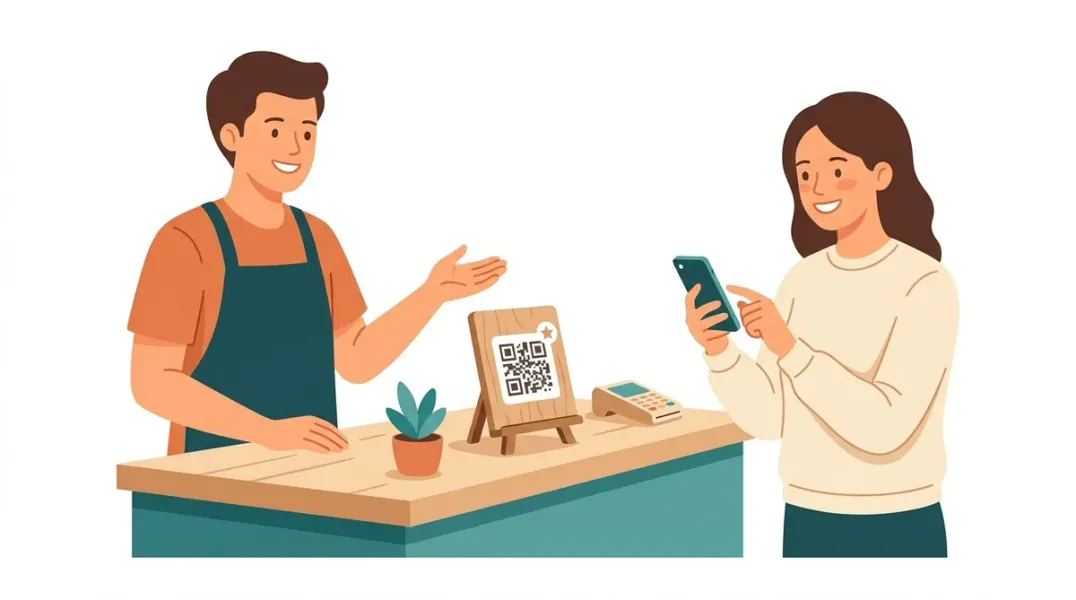
For in-person businesses, a QR code is your best friend. Point a phone camera at it, and people land directly on your review page. No typing, no thinking, just one tap . A simple counter stand with an NFC chip and QR code can convert an active, human-dependent process into a passive, always-on one. It is consistent at 9am Tuesday and 7pm Saturday, and it works regardless of who is on shift or how busy it is .
If you have a physical location, print the QR code on receipts, bag inserts, or table tents. For a café, print it on the cup sleeve with a simple phrase: “Enjoyed your coffee? Tell Google,” alongside a star icon, right where customers look while they wait .
The Follow-Up Sequence That Doubles Response Rates
A single ask is not enough. A gentle follow-up sequence significantly increases response rates without feeling pushy.
The framework looks like this :
- Day 0 (2 hours after service): Send a satisfaction check. “How was your experience? Any issues we should address?”
- Day 1 (if positive response): Send the review request with a direct Google review link. “We are glad you had a great experience. Would you share it on Google?”
- Day 3 (if no response to review request): Send one gentle reminder. “Just a quick follow-up, if you have 30 seconds, your Google review helps us a lot.”
- Stop: Never send more than one reminder. Multiple follow-ups feel pushy and can generate negative sentiment.
A post-purchase note as simple as “Thanks again for your order, we hope you are enjoying it, and if you have a minute your feedback helps other customers and helps us improve” plus a button straight to the review page converts far better than hoping people remember on their own .
What NOT to Do: Google’s Rules and the FTC
Google actively polices review manipulation, and the FTC’s Consumer Reviews and Testimonials Rule, effective October 21, 2024, turned several bad review behaviors into enforceable violations that could result in civil penalties .
Never incentivize positive reviews. Offering discounts, free products, or gifts in exchange for reviews violates Google’s conflict-of-interest policy. You can thank customers with a discount for leaving feedback, but you cannot tie the reward to the rating . Loyalty programs that reward repeat behaviors and then invite satisfied customers to share honest reviews organically are a compliant alternative .
Never gate reviews. Review gating means screening customers and only directing happy ones to Google. Beyond the policy violation, asking everyone produces more authentic, diverse reviews that consumers trust more. A mix of 4-star and 5-star reviews with detailed feedback converts better than a wall of generic 5-star reviews .
Never buy fake reviews or coordinate campaigns. Reviews not based on real experiences, paid reviews, or reviews posted from multiple accounts at someone’s request will be removed. Google may also restrict your profile, block new reviews, unpublish existing ones, or post a public warning that fake reviews were removed .
One correct principle avoids all three traps: invite every real customer to leave their real feelings. The rest is just making that easier and more consistent .
Building a System, Not a Campaign
The businesses that win at reviews have systems. They do not rely on memory, mood, or a single motivated employee. They build a repeatable process that fires at the moment of a positive experience and routes the customer to a one-tap link .
Four habits keep the review drip flowing :
- Ask at the right moment: right after a positive experience—a smooth delivery, a successful service, or a helpful support interaction.
- Make it frictionless: send the short Google review link inside your automated follow-up email or text so the customer lands directly on the review screen.
- Coach your team: train customer service staff on when and how to ask, and give them a simple, flexible line they can adapt, such as: “Thanks so much, we really appreciate that. If you have a second, a quick Google review helps other people find us too.”
- Use templates without sounding robotic: personalize every message with the customer’s name and the specific service they received.
For businesses serving more than 20 customers per month, automation is essential. Connect your CRM or scheduling software to a review management platform that automatically sends review requests after service completion. The key is making automation feel personal—use the customer’s first name, reference the specific service, and keep the message short and warm .
The Real Secret: Over-Deliver
Before any of the tactics above matters, there is one thing that makes everything else work: deliver services and products so good that customers want to leave a glowing review. Happy customers review voluntarily when you remove every barrier .
Ask at the peak moment, right after a client says “This is amazing!” or “I love this.” This is usually right after finishing a project or delivering on a promise. Send them one simple message: “Glad you loved it! Would you mind sharing that feeling with others if it takes you less than a minute? Here’s a direct link to make it easy on you” .
Timing beats everything, and friction equals zero reviews. But none of it works if the underlying experience is not worth talking about.
Responding to Reviews: The Other Half of the Equation
Getting reviews is only half the work. How you respond to them—good and bad—is just as important . Responding to reviews shows customers you value their input, which builds trust and encourages more feedback.
Check your Google Business Profile at least once a week so you can spot patterns early, respond while feedback is fresh, and catch problems before they grow. A consistent 15-minute review takes you past the star rating into the signal underneath it: recurring themes in what customers praise or criticize, repeated complaints that point to an operational issue, and standout staff worth recognizing .
For positive reviews, write a brief personalized response that mentions the author’s name and a specific detail from what they said. Avoid copy-pasted messages like “Thanks for the five stars!” . For negative reviews, acknowledge the frustration, apologize without admitting liability, and offer to resolve the matter offline by providing a phone number or email address .
Conclusion
Getting more Google reviews without annoying your customers is not about being clever or aggressive. It is about being consistent, timely, and frictionless. The businesses that succeed do not beg for reviews. They build a system that invites feedback at the right moment, makes it effortless to respond, and follows up gently without pressure.
The core principles are simple: ask every customer, not just the happy ones. Time your ask to the moment of peak goodwill. Remove every barrier between intent and action. Follow up once, then stop. And above all, deliver an experience worth reviewing.
When you get this right, reviews stop being a campaign and become a byproduct of doing good work. They arrive steadily, month after month, building the trust and visibility that compound into long-term success.
Call to Action
Ready to build a review generation system that runs on autopilot? Start by creating your direct Google review link and QR code from your Business Profile dashboard. Then implement the follow-up sequence outlined in this guide.
Download our Review Request Templates Pack for ready-to-use email, SMS, and in-person scripts. Or contact our local SEO team to set up an automated review system tailored to your business. Your next customer is ready to sing your praises—make it easy for them.
FAQs
Is it against Google’s rules to ask customers for reviews?
No. Google encourages businesses to ask customers for reviews. What is prohibited is incentivizing positive reviews, gating (only asking happy customers), buying fake reviews, or coordinating bulk review campaigns .
How many reviews should I aim to get each month?
Aim for a steady flow of 5 to 15 new reviews per month. Consistency matters more than volume. Sudden spikes followed by long silences look inorganic to Google’s algorithm .
What is the best way to ask for a review in person?
Keep it simple and low-pressure: “Thanks so much, we really appreciate that. If you have a second, a quick Google review helps other people find us too.” Pair it with a QR code so they can act immediately .
Should I follow up if a customer doesn’t leave a review?
Send one gentle reminder, then stop. Never send more than one follow-up. Multiple reminders feel pushy and can generate negative sentiment .
Can I offer a discount in exchange for a review?
You can offer a discount for leaving feedback, but you cannot tie the reward to the rating or require a positive review. The safest approach is to avoid incentives entirely and focus on making the ask easy and well-timed .
Internal & External Links
Internal Links
- How Google Maps Reviews Influence Customer Buying Decisions (Topic 62)
- Google Business Profile Review Responses: What to Say in Different Situations (Topic 63)
- The Complete Local SEO Review Response Strategy for Small Businesses (Topic 65)
- How to Monitor Competitor Google Reviews and Find Market Opportunities (Topic 66)
External Sources
- Google Business Profile Help: Tips to Get More Reviews: https://support.google.com/business/answer/3474122
- Google Business Profile Help: Manage Customer Reviews: https://support.google.com/business/answer/3474050
- FTC Consumer Reviews and Testimonials Rule: https://www.ftc.gov/legal-library/browse/rules/consumer-reviews-testimonials
- BrightLocal Local Consumer Review Survey: https://www.brightlocal.com/research/local-consumer-review-survey/
Grow Your Google Maps Ranking on Autopilot
Stop spending hours every week manually replying to customer reviews and writing Google posts. Busirank automates your Google Business Profile to boost your local SEO rankings and turn searchers into paying clients.

 Busirank Team
