 Busirank Team
Introduction
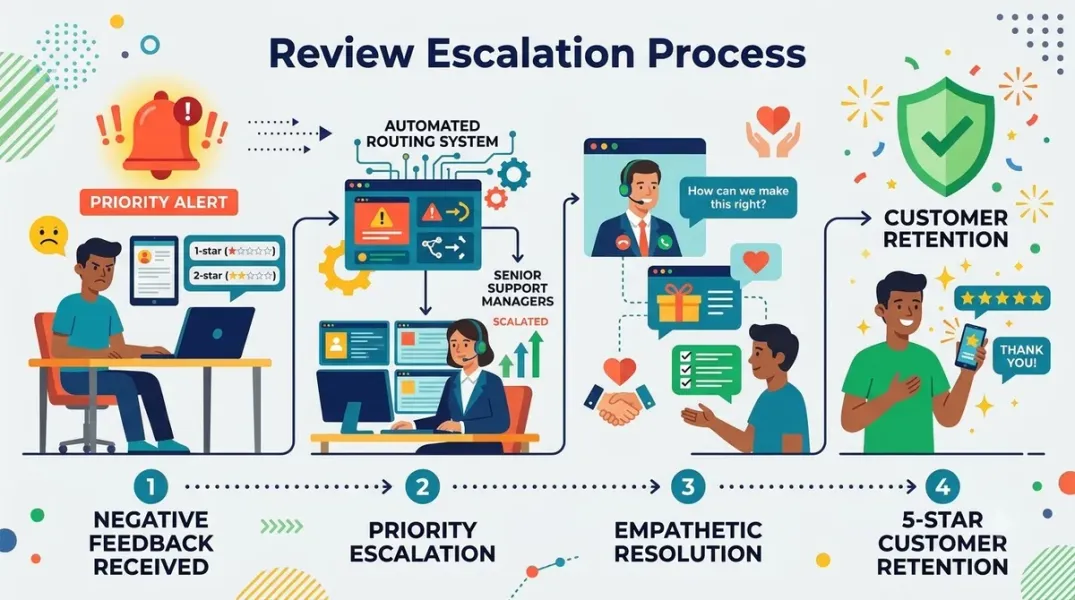
A negative review sitting in a general queue is a reputational exposure window. Every prospective customer who visits the profile reads it, with no counterpoint from the business anywhere nearby. The faster a thoughtful response goes up, the shorter that window is—not because the review disappears, but because it stops being the last word .
The problem is that most businesses treat escalation as a vague instinct rather than a process. Someone senior eventually sees the review, feels it is serious, and forwards it. By then the review has been live for days, the customer has decided nobody cares, and the opportunity for recovery has narrowed.
A negative review escalation workflow solves this by defining severity tiers, named owners, and response clocks measured in hours, not days—before any review arrives . The data behind this is not soft. Responding to a one-star review within 24 hours recovers roughly 30% of detractor scenarios and lifts the original rating in about 33% of cases . Negative reviews answered within 24 hours were revised by the reviewer about 8% of the time, against under 1% when the reply took longer than 72 hours .
This guide covers the framework, the triggers that should never sit in a shared queue, the tools that enforce the clock, and the steps to build a process that runs without a senior person having to spot the problem personally.
Why Escalation Is a System Problem, Not a Judgment Problem
The most common failure in multi-location review management is not neglect—it is inconsistency. One branch manager responds to everything within a day, another checks the profile once a month, and a third has never logged into the dashboard at all. From the outside, three branches of the same brand look like three different companies .
The second failure is ownership ambiguity. Reviews technically belong to marketing, but marketing does not have operational context on what happened at a specific branch on a specific day, so replies come out generic by necessity rather than by choice. The person closest to the actual incident—the branch or store manager—is often the one furthest from the review dashboard .
The third is suspension risk compounding at scale. A single profile with a policy issue is manageable. Fifty profiles run off the same untrained playbook can turn one bad habit into a pattern across a dozen locations before head office notices .
An escalation process fixes all three by replacing individual judgment with defined severity tiers, named owners, and a clock. The goal is not to escalate more. It is to escalate the right reviews to the right person at the right time—and to stop escalating the ones that a trained frontline responder can handle.
Step 1: Define the Severity Tiers Before Any Review Is Triaged
The foundation of the entire process is a written severity framework agreed before the first review is triaged. The clearest model uses three tiers: routine praise, service complaint, and legal or safety allegation .
A more granular five-tier ladder maps cleanly onto review management and gives each tier a different owner, authority level, and response clock:
Tier 0 — Routine positive (4–5 star, no issue). Owner: frontline responder or automation. Clock: 24 hours for a one-click approval or auto-reply. Authority: reply using approved brand voice.
Tier 1 — Mixed or neutral (3–4 star with a concern). Owner: location manager. Clock: same business day. Authority: apologize, ask a clarifying question, offer a standard remedy.
Tier 2 — Service complaint (1–2 star, specific operational failure). Owner: location manager, with visibility to the regional lead. Clock: first touch within 4 business hours, reply within 24 hours. Authority: offer service recovery within a defined limit—a refund, a re-do, a credit.
Tier 3 — High-risk (legal threat, safety incident, discrimination claim, employee misconduct allegation). Owner: escalation officer or operations director. Clock: first touch within 1 hour; move to a private channel the same day. Authority: engage legal, compliance, or HR; do not debate facts publicly.
Tier 4 — Existential (media exposure, regulatory action, viral complaint). Owner: C-level or crisis lead. Clock: immediate. Authority: anything.
The tier ladder from customer support practice provides a useful reference for how this works in practice. A four-tier model runs: Tier 1 team lead (15-minute SLA, 65% resolved at this level), Tier 2 manager (30-minute SLA, 25% resolved), Tier 3 operations director (1-hour SLA, under 10% reach here), and Tier 4 C-level (4-hour SLA, under 1% reach here) . Each tier has clear authority limits, no skipping tiers, and the SLA is first-touch time, not resolution time .
The review-context version uses longer clocks—minutes are not realistic for public review responses the way they are for live support chats—but the structure is identical. Each tier gets a named owner and a response clock measured in hours, not days .
Step 2: Write the Escalation Triggers in Plain Language
A tier framework is only usable if the frontline responder can recognize a Tier 3 review without asking. The triggers have to be written as plain-language rules, published to the team, and reviewed regularly.
The triggers that appear consistently across the 2026 practitioner guidance:
- Legal threats — “lawyer,” “sue,” “attorney,” “legal action,” “report to the authorities.”
- Health and safety issues — injury, illness, unsafe conditions, contamination, medication errors.
- Employee misconduct — discrimination, harassment, assault, theft, a named employee behaving improperly.
- Regulated-category claims — medical outcomes, financial advice, diagnosis disagreements.
- Suspicious clusters — several negative reviews appearing at once, or a pattern that looks coordinated. This routes to whoever owns GBP suspension and reinstatement risk centrally, because a cluster can precede a suspension, not just a reputation problem .
- Viral risk — a review with unusually high engagement or one that has been shared externally.
The rule for the frontline is simple: if the review matches any trigger, do not reply—escalate. The public acknowledgment can be a short, neutral holding response, but the substance moves to a private channel.
The tone rule for Tier 3 is equally important. The protocol should specify that the response maintains a neutral tone, does not go into public detail, and moves the conversation to a private channel . For regulated clients in health, legal, or finance, legal review is a hard gate, not a courtesy .
Step 3: Assign Named Owners and a Backup Roster
Escalation fails when “everyone” is responsible, because that often means nobody is . The structure that scales has two levels of ownership plus an escalation officer.
A branch-level owner—usually the local manager—handles day-to-day responses using the brand’s approved tone and templates as a starting point, not a script . This person owns Tier 1 and Tier 2 reviews for their location.
A regional or head-office owner monitors trends across the portfolio, watching rating drift, response-rate gaps, and spikes in negative sentiment at any one location, stepping in when a branch is clearly falling behind rather than waiting for a complaint to escalate externally . This person owns Tier 2 visibility and Tier 3 first response.
An escalation officer validates or manages sensitive responses in more complex cases . This role decides whether a Tier 3 reply goes out at all, whether the review should be reported to Google, and whether legal or HR should be involved.
The backup roster is the piece most teams forget. Create a simple backup roster for vacations, weekends, and review spikes, and if you have enough locations, designate an after-hours pool for urgent issues . Without a backup, the SLA clock stops the moment the primary owner is unavailable, and the review sits.
Step 4: Set the Response Clock and the Escalation Mechanism
The clock is what turns the process from a policy into an operating standard. The benchmark data supports a tight but achievable set of targets.
Negative reviews (1–2 star): first human touch within 4 business hours, public reply within 24 hours. Consumer expectation is shifting toward speed: 19% now want a reply the same day, up from 6% in 2025, and 32% expect a next-day reply .
Mixed reviews (3–4 star): same-day or next-day response .
Positive reviews (4–5 star): 24 hours for auto-reply or one-click approval.
Tier 3 (high-risk): first touch within 1 hour, private-channel follow-up the same day.
The escalation mechanism is the enforcement. If a review passes its clock without action, the workflow notifies the approver’s backup, not just the original owner. The support-practice model uses automatic escalation if a case hits 80% of its SLA without progress . The same trigger applies to reviews: at 80% of the clock, the system escalates to the next tier’s owner.
The clock is not the resolution time—it is the first-touch time. A review that receives a holding acknowledgment within 4 hours is already better off than one that sits untouched for five days, even if the full resolution takes longer .
Step 5: Use the Right Response Framework for Unhappy Customers
Escalation is about routing. The response itself still has to be good. The framework that reputation managers consistently recommend for negative reviews is LARA: Listen, Apologize, Resolve, Action .
Listen. Read the review twice before typing. Identify the actual complaint underneath the angry phrasing. Most one-star reviews collapse into four categories: price (felt overcharged), communication (no callback, missed window), workmanship (job not done right), or attitude (staff rude or dismissive) .
Apologize without admitting legal fault. The difference matters: “I’m sorry our work was defective” is a legal admission; “I’m sorry your experience did not meet the standard we hold ourselves to” is acknowledgment without admission .
Resolve with a named offline channel. “Please call our office” reads as a brush-off. “Please call me directly, [Name], owner, at [number]” reads as ownership. A named human with a direct line converts a complaint into a conversation .
Action means calling within 24 hours and, after fixing the issue, asking for an updated review. The data supports this: one-star reviews answered within 24 hours recover roughly 30% of detractors, and about 25 to 40 percent of recovered customers write a second review .
The first sentence of the reply must reference the specific transaction or staff member named in the review. Generic acknowledgment is the failure mode that turns a recoverable complaint into a public argument .
The Tools That Enforce the Escalation Process
The tools matter less than the tier framework, but the right tool makes the clock and the routing automatic instead of aspirational.
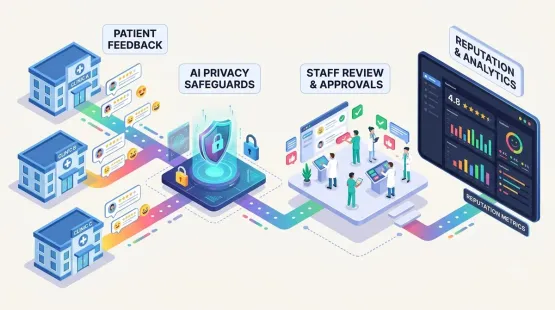
Routing and automation platforms. GMBapi is built on the live Google Business Profile API and supports escalation rules across every location, along with monitoring for deleted reviews and silently rejected replies—a critical feature because Google moderates every reply and a rejected reply generates no notification, it simply never appears . Reviewly.ai provides a centralized multi-location dashboard with response SLAs, escalation rules, and approval workflows, and includes a playbook for escalating 1–2 star Google reviews . ReputRadar lets headquarters define response guardrails, escalation rules, and approval requirements, with auto-posting for routine replies and manual approval for sensitive reviews .
Inbox and workflow tools. ReviewRobot adds an escalation note only when a case needs facts or authority that the normal responder does not have, and treats a three-star review mentioning safety or an employee allegation as an immediate escalation trigger . Sked Social, RecurPost, and SleekFlow put Google reviews into a shared inbox with labels, team assignment, internal notes, and AI-drafted replies, so reviews do not pile up in one person’s queue.
Workflow-automation templates. An n8n workflow template connects Google Business Profile, Gmail, Slack, Google Sheets, and OpenAI to draft review replies and route them, with Slack alerts for the team—a low-cost way to build a custom escalation flow without a platform subscription .
Open-source and AI-driven platforms. The Awesome Reputation Management list catalogues tools with real-time tracking across Google, Facebook, Yelp, Trustpilot, and TripAdvisor, AI review response, and routing workflows with crisis escalation alerts .
For a small team without a platform, a shared inbox plus a Google Sheet with a tier column and a clock column is a working minimum. The discipline matters more than the subscription.
What Recovery Actually Looks Like (and Why Speed Is the Lever)
The data on review recovery is more encouraging than most businesses assume, and it consistently points to speed as the variable that matters most.
A study of 6,412 negative reviews on 328 healthcare profiles found that negative reviews answered within 24 hours were revised by the reviewer about 8% of the time, against under 1% when the reply took longer than 72 hours . In contractor categories, responding to a one-star review within 24 hours recovers roughly 30% of detractor scenarios and lifts the original rating in about 33% of cases .
The cost of delay is equally measurable. Businesses that began handling a reputation crisis more than 30 days after it started took 3.2 times longer to recover than those that started within seven days. Starting within 72 hours cut recovery cost by 60% . At a 4.8 average, it takes about 19 new five-star reviews to offset one one-star review; at 4.5, it takes seven . Speed is cheaper than arithmetic.
And the audience for the response is not only the unhappy customer. 89% of consumers expect business owners to respond to reviews, and 80% are likely to use a business that responds to every review, against 47% for negative-only replies and 45% for positive-only replies . A prompt, professional escalation response is read by every future customer who opens the thread.
Conclusion
Creating a review escalation process for unhappy customers is a governance exercise, not a customer-service gesture. The businesses that recover from negative reviews are not the ones with the most empathetic writers—they are the ones with defined severity tiers, named owners, a clock measured in hours, and a backup roster that keeps the clock running when the primary owner is unavailable.
The framework that holds up across the 2026 evidence is the tiered ladder: routine positive reviews handled by frontline or automation, mixed reviews by the location manager, service complaints by the location manager with regional visibility, and high-risk reviews by an escalation officer within the hour. Each tier has an owner, an authority limit, and a first-touch SLA. The triggers are written in plain language—legal threats, safety incidents, employee misconduct, suspicious clusters—so the frontline can recognize a Tier 3 review without asking.
The results are measurable. A 24-hour response recovers roughly 30% of detractors and lifts ratings in a third of cases . A 72-hour delay cuts the revision rate from 8% to under 1% . A 30-day delay triples recovery time . The clock is the strategy.
Call to Action
Write your three-tier escalation matrix this week, before the next negative review arrives. Define the tiers (routine, service complaint, high-risk), assign a named owner and a backup to each, and set a first-touch clock in hours. Publish the trigger list in plain language—legal threats, safety, misconduct, suspicious clusters—and tell the frontline that matching a trigger means escalate, do not reply. Then pick the narrowest tool that enforces the clock: a routing platform if you manage multiple locations, an inbox with labels and assignment if you do not, or a shared sheet with a tier column and a backup owner if you are starting from zero. Measure the time from review arrival to first human touch for one month, and tighten the tier that keeps breaching its clock.
FAQs
What is a review escalation process?It is a written workflow that defines which negative reviews require escalation, to whom, and within what time. It assigns severity tiers, named owners, authority limits, and first-touch SLAs, so a sensitive review reaches a person with the authority to act rather than sitting in a general queue until someone notices.
How many escalation tiers should a review process have?Three is the practical minimum: routine (positive or neutral), service complaint, and high-risk (legal, safety, misconduct) . More granular models use four or five tiers with different owners and clocks, but three tiers with clear triggers and named owners cover the vast majority of cases without creating a bureaucracy the team will ignore.
How fast should a negative review be escalated?For service complaints (1–2 star), first human touch within 4 business hours and a public reply within 24 hours. For high-risk reviews (legal, safety, misconduct), first touch within 1 hour and a move to a private channel the same day. The support-practice model uses a 15-minute first-touch SLA for its first escalation tier, but review response clocks are typically measured in hours rather than minutes .
What triggers should always be escalated, never auto-replied?Legal threats, health and safety incidents, employee misconduct allegations, regulated-category claims (medical, financial), suspicious review clusters, and viral-risk reviews. These should route to an escalation officer or operations lead immediately, with a neutral public holding response and the substance moved to a private channel .
Who should own the escalation process?A two-level structure: a branch or location manager owns routine and service-complaint reviews, and a regional or head-office escalation officer owns high-risk reviews and decisions about reporting, legal, or HR involvement . A backup roster for vacations, weekends, and spikes is essential, or the clock stops when the primary owner is unavailable .
What is the LARA framework for responding to negative reviews?Listen, Apologize, Resolve, Action. Read the review twice, acknowledge the experience without admitting legal fault, offer a named offline channel, and call within 24 hours to fix the issue and ask for an updated review . The first sentence of the reply must reference the specific transaction or staff member named in the review .
How much does a fast escalation response actually recover?Responding to a one-star review within 24 hours recovers roughly 30% of detractor scenarios and lifts the original rating in about 33% of cases . Negative reviews answered within 24 hours were revised by the reviewer about 8% of the time, against under 1% when the reply took longer than 72 hours .
What tools support a review escalation workflow?GMBapi (escalation rules, rejected-reply monitoring), Reviewly.ai (multi-location SLAs and escalation playbooks), ReputRadar (response guardrails and approval rules), and ReviewRobot (escalation notes and safety triggers) are built for this . n8n workflow templates can connect Google Business Profile, Slack, and Sheets for a custom, low-cost routing flow .
Internal & External Links
Internal links (to other posts in this series):
- How to Build a Google Review Monitoring Workflow for Busy Teams (previous post)
- How to Generate More Customer Feedback With Google Review QR Codes (next in series)
- How to Set Up Review Approval Workflows for Your Marketing Team
- How to Audit Your Team’s Review Responses for Quality and Consistency
- How to Track Review Response Rate and Response Time Across Your Locations
- How to Manage Google Reviews From Multiple Locations in One Dashboard
- Best Google Business Profile Management Software for Small Businesses in 2026
External links (sources referenced in this article):
- Angryturtle.ai — Managing Reviews Across 50+ Locations: https://angryturtle.ai/blog/reviews-multi-location-governance
- Angryturtle.ai — Building a Review Response SLA for Multi-Location: https://angryturtle.ai/blog/review-response-management
- wiReply — How to structure an internal review response protocol for large teams: https://wireply.ai/english/protocol-answers-google-reviews-large-teams/
- wiReply — Multi-Site Review Operations Guide: https://wireply.ai/english/multi-site-review-operational-guide/
- InnovaAI — Review Response Escalation Ladder (QA): https://innovaai.io/academy/learn/sop-fragment/review-response-escalation-ladder-qa—gen-v2-sop-fragment-review-management-0-muxw8y4x
- Jason Athaide (LinkedIn) — Escalation Protocol Framework for Effective Customer Support: https://www.linkedin.com/posts/jasonathaide_escalation-processdesign-operations-activity-7480463183137345537-wvV_
- GMBapi — Google Review & Reputation Management Software: https://gmbapi.com/product/review-management/
- Reviewly.ai — Multi Location Review Management: https://reviewly.ai/2026/04/29/multi-location-review-management/
- PipelineOn — Bad Review Response for HVAC, Plumbing, and Roofing Contractors (LARA Playbook): https://pipelineon.com/blog/hvac-bad-review-response/
- ICG — How Many 5-Star Reviews Offset a 1-Star Review? (Response Time & Rating Recovery Study): https://ichelonconsulting.com/insights/how-many-5-star-reviews-to-offset-a-1-star-review
- Aabore — 2026 品牌聲量修復時間數據報告: https://aabore.com/reports/crisis-recovery-data.php
- CompaniesHistory — Reputation Management Statistics 2026: https://www.companieshistory.com/reputation-management-statistics/
- ReviewRobot — How to Monitor Google Reviews and Get Alerts: https://reviewrobot.ai
- ReputRadar — Manage Google Reviews for Multiple Locations: https://www.reputradar.com
- Awesome Reputation Management (GitHub): https://github.com/ishandutta2007/Awesome-Reputation-Management
- n8n — Draft Google review replies with GPT-5, Gmail, Slack and Sheets: https://n8n.io/workflows/
How to Generate More Customer Feedback With Google Review QR Codes
Grow Your Google Maps Ranking on Autopilot
Stop spending hours every week manually replying to customer reviews and writing Google posts. Busirank automates your Google Business Profile to boost your local SEO rankings and turn searchers into paying clients.
 Busirank Team