 Busirank Team
Introduction
Most local SEO reports are filled with numbers that look good but do not answer the only question that matters: did this work generate sales? Rankings, impressions, and website clicks are useful context, but they are not revenue. The gap between local SEO activity and actual sales is where most reporting fails—and where most budgets get cut.
The data backs this up. A mid-sized business with a $1,500 monthly local SEO investment generating 40 calls and 15 form submissions per month, with a 25% close rate and $500 average customer value, produces $6,875 in attributed revenue—a 4.6x ROI . That is a defensible, revenue-linked result. Yet most local businesses never build this calculation because they lack the tracking infrastructure to connect a Map Pack click to a booked job.
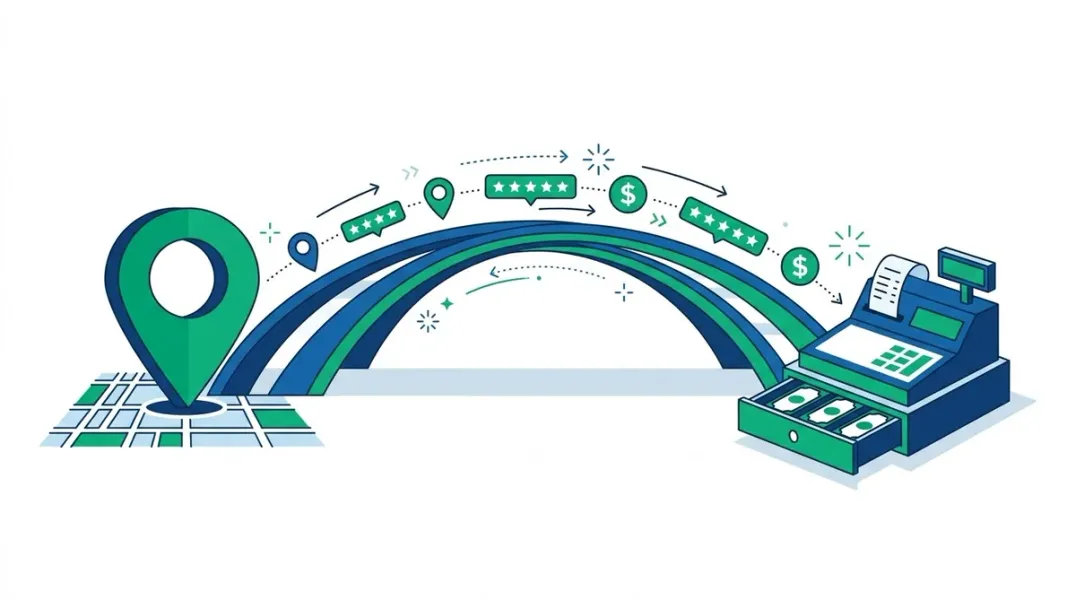
The good news is that the framework is straightforward. You need three things: reliable lead capture, baseline conversion assumptions, and a simple revenue bridge that translates calls and form fills into attributed sales. This guide walks through each step, with the formulas and workflows you need to turn local SEO from a cost center into a measurable revenue driver.
Local SEO metrics fall into three tiers: visibility, engagement, and conversion. Most reports over-index on visibility and ignore conversion—the tier that actually proves ROI .
Visibility metrics (Map Pack position, keyword rankings, GBP impressions) tell you whether you are being seen. They are context, not results.
Engagement metrics (GBP actions, website sessions from local search, click-through rate, review responses) tell you whether people are interacting. They are leading indicators.
Conversion metrics (phone calls, form submissions, direction requests, booking clicks) tell you whether people are becoming customers. These are the metrics that justify the investment .
Flip the reporting ratio. Lead with conversions. Use engagement to explain conversion trends. Use visibility only as supporting context.
Step 1: Set Up Conversion Tracking
Without conversion tracking, you cannot connect local SEO to sales. At minimum, implement three tracking mechanisms :
Call tracking with unique numbers. Assign a dedicated tracking number to your Google Business Profile listing. Every call that comes through GBP is recorded, time-stamped, and attributed to local search . Use a platform like CallRail or CallTrackingMetrics. Dynamic number insertion (DNI) can also swap numbers on your website based on the referral source—so a visitor from Google Maps sees a different number than one from a paid ad .
GA4 with UTM parameters on GBP website links. Tag your GBP website link with UTM parameters like ?utm_source=google&utm_medium=gbp&utm_campaign=local_seo. This creates a separate traffic segment in GA4 that isolates visits originating from your Google Business Profile .
Google Tag Manager events for form submissions, click-to-call, and bookings. Configure conversion events for every action that signals revenue intent: form submission confirmation page views, booking widget completions, click-to-call events, and live chat initiations .
The goal is a clear attribution chain: local search impression → click → GBP action or website visit → lead → customer .
Step 2: Establish Your Baseline Assumptions
Before you can calculate revenue, you need two numbers from your business: average transaction value and average close rate from inbound leads .
Ask these questions:
- What is your average job or order value?
- Of every 10 inbound calls from new customers, how many become paying clients?
A plumber with a $450 average job value and a 60% close rate on inbound calls produces $270 of expected revenue per qualified call . Record these figures in your reporting template and treat them as fixed assumptions unless something changes.
This baseline is what converts a call count into a revenue figure. Without it, you are reporting activity, not outcomes.
Step 3: Build the Revenue Bridge Formula
The formula is simple:
Attributed Revenue = Leads from Local SEO × Close Rate × Average Customer Value
For example, if your GBP and location pages generate 40 calls and 15 form submissions per month (55 total leads), and your sales team converts 25% of leads into customers with an average value of $500, your local SEO program generates approximately $6,875/month in revenue .
$6,875 = (55 leads × 25% × $500)
If your local SEO investment is $1,500/month, that is a 4.6x ROI .
Apply conservative attribution to account for seasonality and other marketing factors. Attributing 70% of incremental leads to local SEO is a defensible middle ground that prevents overclaiming while still demonstrating clear value.
Step 4: Filter for Qualified Leads
Not every call is a lead. A misdial, a wrong number, or a 15-second hang-up does not belong in your revenue calculation.
Export call data monthly and filter for calls over 60 seconds—the threshold that indicates a genuine conversation rather than a misdial . For form submissions, filter for submissions that include valid contact information and a service inquiry that matches your offerings.
That filtered number is what goes into your revenue calculation.
Step 5: Account for Customer Lifetime Value
Most ROI calculations undercount local SEO’s value because they only measure the first transaction. A customer acquired through local search has a lifetime value that extends far beyond their initial purchase .
A dental patient found through local SEO may generate $5,000 or more in revenue over five years. A home services customer may use you for dozens of projects. A restaurant regular may visit monthly for years.
Factor lifetime value into your calculation for a more accurate picture. If your average first transaction is $500 but customers return an average of three times over two years, your effective customer value is $1,500—tripling the attributed revenue from the same lead volume .
Step 6: Track the Leading Indicators
Revenue is a lagging indicator. By the time you see sales increase, you have already done the work. Track leading indicators monthly to predict future revenue and catch problems early .
Lead quality over lead volume. A useful mental shift: if reports look great but sales disagree, trust sales first. SEO data should explain revenue, not argue with it . Track which leads from local search actually convert and which do not. A high volume of unqualified calls is not success.
Sales cycle shortening. When local SEO works, sales cycles often shorten before revenue spikes. Customers arrive more informed, more ready to buy, and with fewer objections .
Geographic coverage expansion. If you serve multiple areas, track where your leads are coming from. Geo-grid rank tracking can show whether you are appearing in the top three across more neighborhoods over time—and whether those new areas correlate with increased call volume .
Common Attribution Mistakes to Avoid
Last-click attribution. Customers do not convert on the last click. They follow complex paths across multiple channels before booking. A Carrectly case study found that customers moved through Google Search → Facebook Ad → Yelp Reviews → Instagram → Booking before converting . Last-click attribution would credit Instagram for a sale that started with Google.
Platform self-reporting. Each platform inflates its own contribution. Facebook’s internal metrics may look strong while its actual customer acquisition cost is higher than reported. Trust your own tracking, not the platform’s .
Ignoring offline conversions. Local leads often convert offline—phone calls, walk-ins, bookings. If tracking stops at clicks, revenue attribution breaks down immediately .
Over-reliance on rankings. Rankings show visibility, not buying intent. Being #1 for a keyword does not mean you are showing up when ready-to-buy searches happen. Rankings are a means, not an end .
Conclusion
Connecting local SEO metrics to actual sales is not complicated, but it does require intention. The framework is simple: set up conversion tracking, establish your baseline assumptions, apply the revenue bridge formula, and track leading indicators alongside lagging ones.
The businesses that do this work gain a decisive advantage. They can prove which local SEO activities generate revenue. They can defend their budgets with data. They can make smarter decisions about where to invest time and money.
Start with call tracking on your GBP listing. Add UTM parameters to your website link. Define your average transaction value and close rate. Then run the formula. You will likely discover that your local SEO is driving more revenue than you realized—and you will finally have the numbers to prove it.
Call to Action
Ready to prove your local SEO ROI with real numbers? Start by setting up call tracking on your Google Business Profile. Then build your revenue bridge formula with your average transaction value and close rate.
Download our Local SEO Revenue Calculator to plug in your numbers and see your attributed revenue instantly. Or contact our local SEO team to build a complete attribution system that connects your search visibility to actual sales.
FAQs
What is the simplest way to connect local SEO to sales?
The simplest formula is: Leads from local SEO × Close rate × Average customer value. If your GBP generates 30 calls and 10 form submissions per month (40 leads), with a 25% close rate and $500 average value, your attributed revenue is $5,000 per month .
How do I track calls from my Google Business Profile?
Use a dedicated tracking number assigned to your GBP listing through a platform like CallRail. Every call that comes through that number is recorded and attributed to local search. Google Business Profile also provides free call insights, but they only count clicks on the Call button, not connected calls .
What if I don’t have call tracking?
You can start with free methods. Add UTM parameters to your GBP website link and track click-to-call events in GA4. Use Google Voice as a free tracking number for your GBP. These methods are less precise but provide a starting point .
How do I account for customers who don’t call or fill out a form?
Ask every new customer “How did you find us?” and track the responses. Also, consider using a CRM to track the original source of every job. The more accurately you track, the more clearly you will see local SEO performance .
What is a realistic ROI for local SEO?
Local SEO typically delivers 400-800% ROI, though results vary by industry and ticket size. High-ticket service providers (legal, medical, home services) tend to see the strongest returns because each converted lead carries enough value to absorb the acquisition cost many times over .
Internal & External Links
Internal Links
- Google Maps Clicks vs Calls: Understanding Customer Behavior (Topic 69)
- How to Track Phone Calls Generated by Local Search (Topic 70)
- Local SEO Attribution: How to Know Which Searches Generate Customers (Topic 72)
- How to Create a Local SEO Dashboard for Business Owners (Topic 73)
External Sources
- Locafy: Local SEO Reporting — What to Track and How to Show ROI: https://locafy.com/blog/local-seo-reporting
- Locafy: Local SEO ROI — How to Calculate and Maximize Your Return: https://www.locafy.com/blog/local-seo-roi
- Search Engine Journal: How To Connect AI Search Visibility To Local Leads: https://www.searchenginejournal.com/how-to-connect-ai-search-visibility-to-local-leads/588096/
- ServiceTitan: Measure Business Impact of GBP with Reputation Revenue Reporting: https://help.servicetitan.com/release-hub/docs/measure-business-impact-optimizing-google-business-profile-reputation-revenue
Grow Your Google Maps Ranking on Autopilot
Stop spending hours every week manually replying to customer reviews and writing Google posts. Busirank automates your Google Business Profile to boost your local SEO rankings and turn searchers into paying clients.

 Busirank Team
