 Busirank Team
Introduction
Most agency churn in local SEO does not start in month three. It starts in onboarding, on the day the baseline was never recorded in a way the client could verify. The agency does the work, the ranking moves, and the client—who never saw the starting line—cannot tell whether anything happened. The relationship ends, and the agency blames the algorithm.
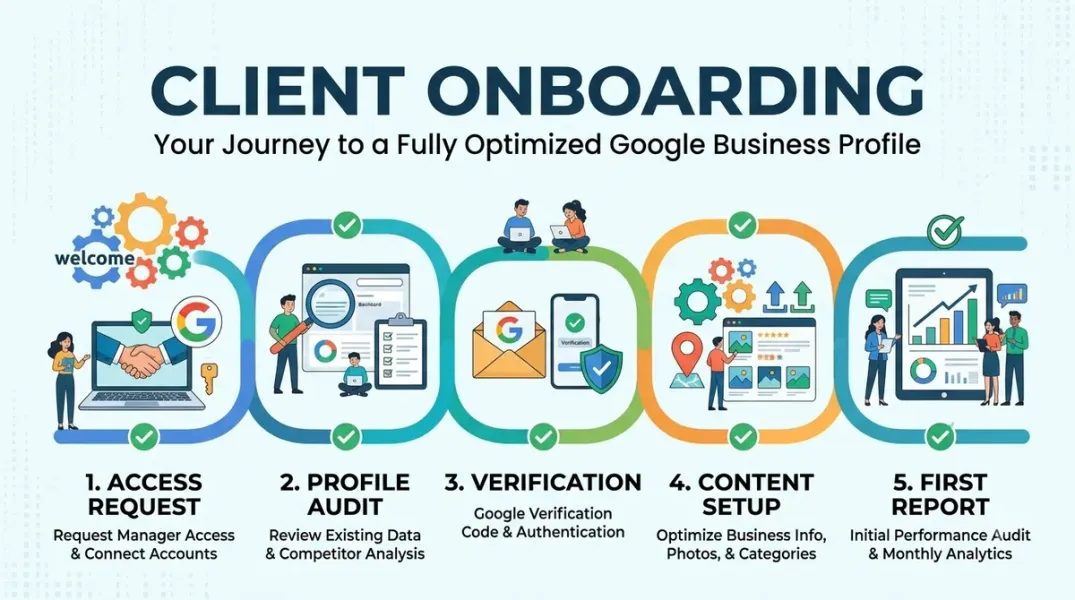
A Google Business Profile client onboarding process exists to prevent that outcome. It is not a welcome email and a login request. It is a repeatable sequence that fixes access before strategy, records the before-state before the first edit, flags risk before the first optimization, and delivers a ranked plan instead of a 70-point audit dump.
The stakes are concrete. Profile completeness, category selection, and review signals account for the largest share of local pack ranking signals at 32%, more than any other single factor. An onboarding that touches the wrong fields first, or edits before recording the baseline, can set a client back months before the engagement has properly begun.
This guide lays out the sequence that holds up across agencies managing dozens of profiles—access, NAP, baseline, risk audit, prioritized plan, and handover record—and the specific mistakes that turn onboarding into a rescue job.
Why Onboarding Breaks (and Why It Is an Operating System Problem)
The failure points are consistent across agencies, and none of them are Google’s fault. Access lives in personal Gmail accounts. Clients send hours changes by email after the holiday already passed. Reviews pile up. Q&A gets ignored. Posts happen only when someone remembers. Then the client asks why calls are down.
PostPlanify frames the diagnosis precisely: this is not a Google problem, it is an operating system problem. For agencies, GBP management should be a repeatable service line with onboarding, permissions, optimization rules, content workflows, review handling, and reporting—not a series of custom rescue jobs.
The practical rule that separates a service from a risk: if a client update depends on one account manager remembering to log into Google manually, you do not have a service. The onboarding process is what replaces memory with structure.
Step 1: Fix the Access Model Before Touching Anything
The single most common onboarding mistake is asking for the wrong kind of access—either too little to do the work or too much for a client to feel comfortable granting.
The rule is unambiguous: request Manager access, never ownership transfer. A Manager can edit business information, respond to reviews, publish posts, and view insights—everything an agency needs operationally—while the client retains Owner status and can remove agency access at any time without escalating to Google. Ownership transfer is a bigger ask than the work justifies, and it creates a real problem when the relationship ends: the client has to reclaim their own profile from a vendor.
The access request should cover four assets at minimum: Google Business Profile (Manager), website (admin or editor), Google Analytics (Viewer or Analyst), and Search Console (Owner or Full User). Existing citation logins, if the client has any, should be recorded so the agency does not create duplicate accounts on directories the client already holds.
The account architecture that makes this manageable at scale is an agency organisation account, created on a Google account tied to the agency domain—not a personal Gmail. One critical rule: the account used to set up the organisation must not currently own or manage any individual GBP listings, because pre-existing profile connections cause setup failures that require Google support to resolve.
Step 2: Build the Master NAP Sheet Before a Single Listing Is Touched
Before any optimization, agree the exact name, address, and phone number in one document both sides sign off on. This becomes the reference every citation gets checked against, during the initial build and every audit after.
The sheet should capture more than the current facts. It needs legal and display business name (no keyword stuffing), full address with suite formatting, phone number with consistent country-code handling, the canonical website URL (with or without www), and—critically—past business names, past addresses, and past phone numbers.
Those last three rows matter more than they look. Pre-build citation audits regularly turn up listings that already exist under a previous brand name or an old phone number—exactly the kind of thing a client will not think to mention unless asked directly. Getting this history on the sheet at onboarding, rather than discovering it mid-build, is what keeps a citation build from adding a fresh, correct listing next to three stale, wrong ones.
NAP inconsistency is also the single biggest local-ranking hygiene factor across the profile and citations, and call-tracking number swaps are a common culprit. The master sheet is the control.
Step 3: Record the Baseline Before the First Edit
A baseline is only useful if it is recorded before work starts, and it has to be clear enough that the client could check it themselves. This is the step that prevents month-four churn, because it is the only evidence that the work changed anything.
The baseline should capture profile health, map visibility, review count and average rating, category and service setup, NAP consistency, and current performance metrics—calls, direction requests, website clicks, and profile views where available. Save screenshots and scan results before any edit.
The explicit prohibition is worth stating in the SOP: do not make GBP edits before recording the baseline. And do not promise rankings in the onboarding call. Local SEO often gets worse when teams make broad profile, category, landing-page, or tracking changes without a baseline; the sequence is evidence first, then the smallest safe changes that address the biggest leak.
Step 4: Audit for Risk Before You Audit for Optimization
The first-week audit should not be a ranking opportunity scan. It should be a risk scan, because suspensions, duplicates, misleading fields, or broken ownership can block every other improvement.
The priority order that holds up across onboarding frameworks is: 1) policy and profile risk (suspensions, duplicates, misleading fields, broken ownership), 2) customer path leaks (can people call, book, and understand the offer), 3) relevance gaps (services, categories, pages, review language matching the searches that matter), 4) competitor gaps, and 5) reporting.
The configuration mistakes worth checking at every onboarding are consistent: untagged website links (profile traffic gets bucketed as organic or direct unless UTM-tagged), NAP inconsistency, and silent suspensions or unverified edits that quietly tank map-pack visibility without an obvious alert.
Duplicate and overlapping signals are a specific risk. Google hates duplication and overlapping signals confuse the algorithm, so it chooses one profile to show and suppresses the rest—which is why an onboarding audit that finds four profiles sharing the same address, category, and service areas should flag that before any optimization begins.
Step 5: Deliver a Ranked First-30-Days Plan, Not an Audit Dump
The deliverable of onboarding is not a 70-point audit. It is a short, prioritized action list the client can understand. The goal is not to touch every setting; it is to find the few changes most likely to improve local visibility, trust, and conversion without creating avoidable GBP risk.
A workable first-30-days plan has three sections: what will be fixed this week (risk items and customer-path leaks), what will be fixed this month (relevance and competitor gaps), and what needs client input before anything moves (missing photos, category decisions, hours confirmation). The plan should be ranked, not exhaustive, and it should name the metric each fix is expected to move.
The pacing that prevents overreach is a five-phase sequence: Day 1 kickoff and paperwork, Days 1–3 access collection, Days 3–7 baseline and setup, Days 7–14 strategy and first wins, and quick-win fixes shipped within the first two weeks.
Step 6: Record the Handover and Respect the 7-Day Restriction
Onboarding is often also a handover, and the record matters as much as the access. The handover record should document the business name, profile URL, authorized representative, current primary owner account, all current owner and manager accounts, the outgoing provider, the new provider, the handover date, and any open issues.
One technical rule is easy to miss and causes real friction: a new owner or manager may be unable to remove users, transfer primary ownership, delete or undelete the profile during the first 7 days. The onboarding schedule has to account for that window, or the first week will be spent waiting on a permission Google will not grant yet.
The access hygiene rules that belong in the SOP are equally specific. Google Groups cannot be added as owners or managers. Each person uses their own Google Account—no shared passwords. And the business should review the full user list and keep only essential owners and managers after the handover completes.
The Onboarding Checklist as the Repeatable Artifact
The process becomes repeatable when it lives in a checklist that every client goes through in the same order. The structure that works is deliberately short: confirm the business, locations, services, and priority markets; collect GBP, website, analytics, call-tracking, and reporting access; capture the current profile state before changes; run a first-pass local visibility and competitor scan; and deliver a ranked plan.
That checklist is the asset. It is what lets a new account manager onboard a client to the same standard as a senior team member, and it is what makes the service line sellable rather than bespoke. The alternative—treating GBP onboarding as a quick task—is what produces the failures the configuration audits keep finding: agencies using their own email, hiding ownership from the client, or violating Google’s Additional Terms by keyword-stuffing the business name.
Conclusion
A repeatable Google Business Profile onboarding process is not administrative overhead. It is the structural defense against churn, and it has six parts: Manager access instead of ownership, a master NAP sheet signed off before any listing work, a baseline recorded before the first edit, a risk-first audit that checks suspensions and duplicates before opportunities, a ranked first-30-days plan instead of an audit dump, and a handover record that respects Google’s 7-day ownership restriction.
The reason to build it this way is that local SEO produces slow, compounding results, and clients stay patient when they can see the starting line. A client who has the baseline in hand, the risk list explained, and a ranked plan on the calendar does not need to be convinced the work is happening. A client who was asked for logins and promised rankings has nothing to hold onto when month three arrives.
The checklist is the product. Build it once, run it every time, and onboarding stops being a scramble and becomes the first proof that the agency runs a process.
Call to Action
Build the onboarding checklist this week and run it on your next new client. Copy the four pillars into a single document: access to request (Manager on GBP, admin on site, Viewer on Analytics, Full User on Search Console), master NAP sheet (including past names, addresses, and phone numbers), baseline capture (screenshots and metrics before any edit), and a ranked first-30-days plan. Add the risk-first audit order and the 7-day ownership restriction to the SOP. Then time how long the first run takes—that number is your onboarding cost, and it is also your onboarding standard. If you manage multiple clients, put the checklist inside your project management tool so every new engagement starts from the same template rather than from an account manager’s memory.
FAQs
What is Google Business Profile client onboarding?It is the repeatable sequence an agency runs before optimization begins: requesting the right access, building a master NAP sheet, recording a baseline, auditing for risk, delivering a prioritized first-30-days plan, and documenting the handover. It is the step that determines whether the client can later verify that the work produced results.
Should an agency request ownership or manager access on a client’s GBP?Manager access, never ownership transfer. A Manager can edit information, respond to reviews, publish posts, and view insights—everything an agency needs—while the client retains Owner status and can revoke access without involving Google. Ownership transfer creates a reclaim problem when the engagement ends.
What should be in a master NAP sheet for GBP onboarding?Legal and display business name, full address with suite formatting, phone number with consistent country-code handling, canonical website URL, and past business names, addresses, and phone numbers. The history fields catch stale listings that the client will not think to mention but that will conflict with a new citation build.
Why does the baseline have to be recorded before any GBP edits?Because a baseline recorded after edits cannot prove what changed, and most local SEO churn starts when the client cannot verify progress. The rule in onboarding SOPs is explicit: do not make GBP edits before recording the baseline, and do not promise rankings in the onboarding call.
What should an agency audit first during GBP onboarding?Risk, not opportunity. The priority order is: policy and profile risk (suspensions, duplicates, misleading fields, broken ownership), then customer path leaks, then relevance gaps, then competitor gaps, then reporting. Risk items come first because they can block every other improvement.
What is the 7-day GBP ownership restriction?A new owner or manager may be unable to remove users, transfer primary ownership, delete, or undelete the profile during the first 7 days. Onboarding schedules need to account for that window rather than plan access changes on day one.
What common GBP configuration mistakes should be checked at every onboarding?Untagged website links (profile traffic gets misattributed), NAP inconsistency (including call-tracking number swaps), and silent suspensions or reverted edits that quietly suppress map-pack visibility. All three are auditable in the first week and all three are cheaper to fix before optimization begins.
Internal & External Links
Internal links (to other posts in this series):
- How to Track Review Response Rate and Response Time Across Your Locations (previous post)
- How to Manage Google Business Profile Content for Franchise Networks (next in series)
- How to Manage Google Business Profiles for Multiple Clients Without Account Chaos
- How to Set Up Team Permissions for Secure Google Business Profile Management
- How to Create White-Label Local SEO Reports for Your Agency Clients
- How to Standardize Local Marketing Tasks Across a Distributed Team
- Best Google Business Profile Management Software for Small Businesses in 2026
External links (sources referenced in this article):
- Local SEO Citation Builder — Local SEO Client Onboarding Checklist for Agencies: https://localseocitationbuilder.com/blog/local-seo-client-onboarding
- SEOG.ai — Local SEO Client Onboarding Checklist: What Agencies Should Audit in the First Week: https://seog.ai/blog/local-seo-client-onboarding-checklist-agencies
- Authority Stack — How Digital Agencies Manage Google Business Profiles for Multiple Clients: https://authoritystack.ai/gbp/how-digital-agencies-manage-google-business-profiles-for-multiple-clients
- PostPlanify — Google Business Profile Management: Agency Playbook (2026): https://postplanify.com/blog/google-business-profile-management
- Maps Agent — Agency offboarding and onboarding checklist for Google Business Profile: https://maps-agent.com/guides/agency-offboarding-and-onboarding-checklist
- Phloz — Google Business Profile integration for agencies (configuration gotchas): https://phloz.com/integrations/google-business-profile
- Agency Dashboard — How Agencies Can Manage Google Business Profile for Clients: https://agencydashboard.io/blog/agency-dashboard-gbp-management
- Reinstated.net — Two Suspensions, One Client, One Mistake I Owned: https://reinstated.net
- Authority Stack — Multi-Location Client Onboarding Workflow Differences: https://authoritystack.ai
How to Manage Google Business Profile Content for Franchise Networks
Grow Your Google Maps Ranking on Autopilot
Stop spending hours every week manually replying to customer reviews and writing Google posts. Busirank automates your Google Business Profile to boost your local SEO rankings and turn searchers into paying clients.
 Busirank Team