 Busirank Team
Introduction
Monitoring tells you what happened. Auditing tells you why it happened and what to fix next . Most teams stop at monitoring: they see the response count, the average rating, maybe the response time, and they assume the program is working. It is not the same thing. A team can hit a 95% response rate while publishing boilerplate replies that quietly erode trust, and a dashboard will never show it.
That gap is the case for review response quality management. A response audit is not a vibe check or a spot-read of the last ten replies. It is a structured, scored, repeatable evaluation of the responses your team publishes—against a written rubric, across a defined sample, with the findings routed to the people who can fix them.
The stakes are measurable. A study of 9,422 support conversations found that scripted or generic wording triggered 53.7% of cases where customers doubted they were talking to a real person—more than every other cause combined—and those conversations averaged a satisfaction score of 1.64 out of 5, against 3.14 where the doubt did not surface . Wording, not speed, was the story. An audit is the only mechanism that catches it.
This guide covers the audit framework, the scoring rubric, the sampling method, the multi-location tiering that makes it practical at scale, and the tools that automate the mechanical parts so your team can focus on the judgment.
What a Response Audit Actually Covers
A review audit that only reads reply text is incomplete. The operational framework that agencies and multi-location teams use evaluates four layers together: profile hygiene, response operations, request compliance, and performance reporting . Auditing one layer gives an incomplete picture and a weak improvement plan.
For a response-focused audit, the layers that matter most are response operations—speed, relevance, tone, escalation handling—and the governance layer that determines whether the audit findings actually produce corrective action . The profile layer still belongs in the audit, because a reply can be perfectly written and still be wrong if the hours listed on the profile are out of date.
Build the Scoring Rubric Before You Read a Single Reply
The difference between an audit and an opinion is the rubric. A rubric turns “this reply feels generic” into a scored judgment that two reviewers can apply consistently.
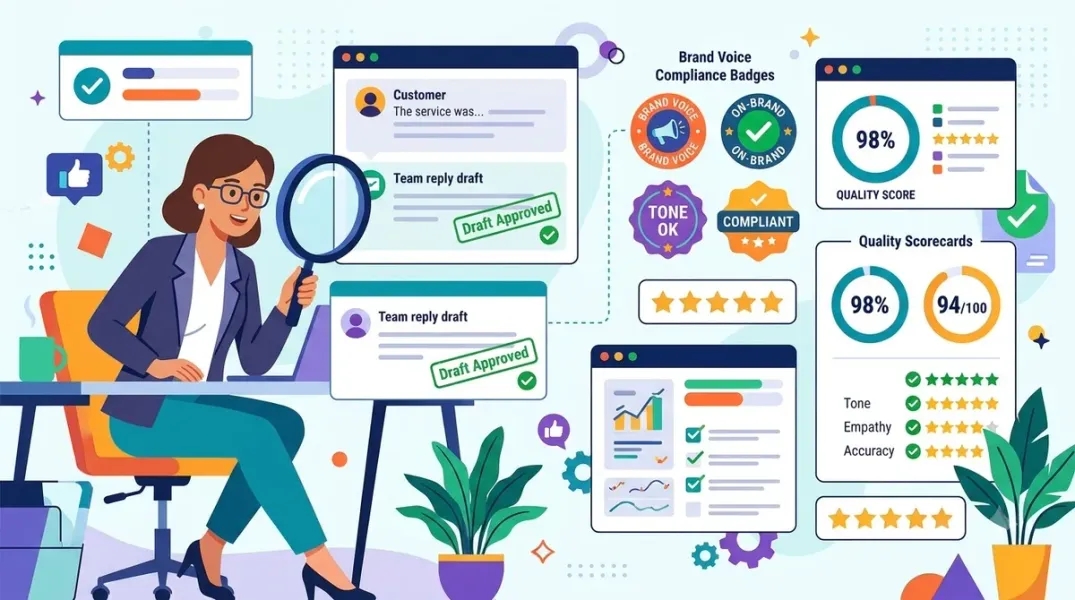
The five-dimension rubric that holds up in practice scores each response on a 1–5 scale across: relevance to the issue, tone and professionalism, action clarity, policy safety, and personalization and voice. The target threshold is 20 out of 25 . A reply that scores 12/25 is not a style preference—it is a measurable failure on four of five dimensions.
A second, more granular rubric set arrives from the tooling side. AI-based scorers now evaluate tone alignment (does the response tone match the review sentiment), resolution adequacy (do negative reviews contain an actual resolution), template uniqueness, length efficiency, and personalization . These five capabilities map almost directly onto the manual rubric, which is useful: it means the manual audit and the automated audit are measuring the same things, and you can calibrate one against the other.
The rubric should be written down, published to the team, and used consistently across every reviewer. A rubric that lives only in a manager’s head produces audits that cannot be compared across months, locations, or reviewers.
The Sampling Method That Produces Defensible Findings
You cannot read every reply. You need a sample that is large enough to be representative and structured enough to catch the failures that matter.
The sampling frame that works for a response audit has three strata:
Stratum 1 — Negative reviews (1–2 star). Sample 100% or as close to it as volume allows. These are the replies with the highest reputational and legal exposure, and they are where the generic-reply problem does the most damage.
Stratum 2 — Mixed and neutral reviews (3–4 star). Sample a random 20–30%, or a fixed number per reviewer per month. This is where inconsistency between team members is most visible, because there is no obvious template to fall back on.
Stratum 3 — Positive reviews (4–5 star). Sample a random 10%, weighted toward replies that were auto-generated or AI-drafted. The risk here is template sameness rather than appropriateness, so the audit is looking for uniqueness and personalization, not just politeness.
The audit should also include every reply flagged by a customer or escalated internally, and every reply that was published after a policy warning or rejection. These are the cases where the process already told you something was wrong.
The Multi-Location Audit Problem (and the Tiering That Solves It)
The audit that takes three days for a ten-location client will take three weeks for a fifty-location client—and it will be partially stale by the time it finishes . The answer is not a less thorough audit. It is tiering.
The tiered model that agencies use at 50+ locations segments the portfolio by revenue potential and visibility risk. Tier 1 locations—the top 20% that drive 60–70% of local conversions—get a full manual audit quarterly at minimum, covering every field and every review response pattern. Tier 2 mid-volume locations get a structured checklist audit every six months, and any location that fails more than three criteria moves up to Tier 1 temporarily. Tier 3 long-tail locations get automated monitoring for critical signals and a light manual review once a year, escalating to Tier 2 if an anomaly appears .
The same segmentation applies to the response audit specifically. Tier 1 locations get a larger sample and a full rubric score. Tier 2 locations get a smaller sample and a pass/fail check on the highest-risk dimensions (relevance, policy safety, resolution adequacy). Tier 3 locations get automated scoring plus a manual review only of failures.
A separate segmentation layer is essential inside each tier: audit by region, location type, and owner . A group average hides the manager whose replies consistently score 14/25 while the team average sits at 21/25. The audit has to break out response quality by manager cohort, not just by location, or the lowest performer is invisible.
What to Look For (and the Specific Failure Modes)
The rubric gives you the score. The failure modes tell you what to hunt for.
Generic acknowledgment. The reply thanks the customer and says nothing that could only have been written about that review. The Hugo data is the clearest evidence: 53.7% of flagged doubt was triggered by scripted or generic wording, and the average satisfaction in those cases was 1.64 .
Missing resolution on a negative review. The reply apologizes but offers no next step, no private channel, no named contact. A resolution-adequacy check should flag this automatically .
Tone mismatch. A cheerful, exclamation-heavy reply under a one-star complaint reads as tone-deaf. A defensive or legalistic reply under a mild three-star review reads as overreaction.
Template sameness at scale. Twenty positive replies with the same opening and the same closing are not twenty replies. They are one reply published twenty times, and the rubric dimension for personalization should catch it .
Policy risk. Any reply that confirms clinical or legal detail, promises a refund or remedy, or references a named employee in a negative context should be flagged and routed immediately. The healthcare benchmark found zero suspensions across 6,412 negative reviews when policy-safe response templates were used—which is the argument for auditing policy safety separately from tone .
The specific-experience rule. The healthcare data shows that responses which acknowledged the specific experience without confirming clinical detail were associated with 2.1× the reviewer-edit rate of generic “sorry to hear that” responses . Specificity is not a style preference. It is the variable that separates a reply that recovers the customer from one that does not.
Separate Speed From Quality (and Audit Both)
Speed and quality are different metrics and they must be measured separately, or the team will optimize one at the expense of the other . The benchmark data makes the case: the average business takes 2.7 days to respond, 32% of consumers expect a next-day reply, and only 54% of reviews receive any response at all . A team that hits a 24-hour response target but publishes 15/25 replies has hit the wrong target.
The audit should report response coverage (percentage replied to), median first-response time by rating tier, and the average rubric score, side by side. A drop in quality after a speed push is the predictable outcome of asking the same people to do more with the same time—and the audit is what makes the trade-off visible before it becomes a reputation problem.
The 24-hour window is the quality cliff for negative reviews: responses inside 24 hours were associated with an average 0.34-star recovery on the 90-day rolling rating, roughly six times the recovery of responses after 72 hours, and the reviewer edit rate was 8% inside 24 hours against under 1% after 72 hours . Speed is not a vanity metric. It is the variable that determines whether the reply has a chance to work.
The Audit Cadence and the Feedback Loop
The audit only produces improvement if it runs on a cadence and the findings loop back to the people who wrote the replies.
The cadence that works is monthly for the sample, quarterly for the full manual review on Tier 1 locations, with an immediate triggered audit after any policy incident or escalation . The monthly sample should be small enough to complete in a single session—20–30 replies per reviewer cohort is enough to identify a pattern—and large enough to include every negative review published that month.
The feedback loop has three parts. Per-reviewer scorecards so each person sees their own trend, not just the team average. A calibration session where two reviewers score the same sample and compare, so the rubric does not drift. And a weekly or monthly quality review where the top three failure modes from the audit are named and addressed, rather than a 20-page report that nobody reads.
The tooling now automates the mechanical layer of this loop. Quality scorecard platforms replace spreadsheet audits with configurable rubrics, weighted dimensions, and automatic notification to the person being scored—one team reported cutting audit time from 20 minutes per case to 10 minutes and eliminating a 10% error rate that came from manual spreadsheet entry . For review responses specifically, AI scorers can run tone alignment, resolution adequacy, template uniqueness, and personalization checks across the full corpus, so the human audit can focus on the borderline cases .
The workflow that scales is automated scoring for coverage, human scoring for judgment. The machine reads every reply and flags the ones that fail a threshold or cluster into a pattern. The human reads the flagged sample, applies the rubric, and decides what the pattern means.
Conclusion
Auditing your team’s review responses for quality and consistency is a governance exercise, not a proofreading exercise. The audit that works has four components: a written rubric with five scored dimensions and a defined pass threshold, a stratified sample that over-weights negative reviews, a tiered multi-location structure so the audit does not collapse under its own scale, and a feedback loop that routes findings to named reviewers with a cadence that holds.
The evidence for doing it is specific. Generic wording is the single largest trigger of customer doubt, at 53.7% of cases, and it costs 1.5 points of satisfaction when it lands . Specific acknowledgment of the experience is associated with 2.1× the reviewer-edit rate of generic apology . And speed without quality produces the appearance of responsiveness while the replies themselves do the opposite of their job.
The tools make the mechanical part easier—automated scoring, scorecard platforms, and flagged-reply queues—but the judgment stays with the team. The audit is the mechanism that turns that judgment into a standard, and the standard into consistency across every location and every reviewer.
Call to Action
Build the rubric before you read the first reply. Write down the five dimensions—relevance, tone, action clarity, policy safety, and personalization—and define what a 5, a 3, and a 1 look like on each. Publish it to the team. Then pull a stratified sample of last month’s replies: all negative reviews, a random 20% of mixed reviews, and a random 10% of positive reviews. Score them, and break the results out by reviewer, not just by team average. Pick the lowest-scoring dimension and make it the focus for next month. If you manage multiple locations, apply the tiering first: full audit on your top 20%, checklist audit on the middle, automated monitoring on the long tail. Add one AI scorer for coverage if you can—tone alignment and resolution adequacy are the two dimensions it handles best—and use the human audit only for the flagged cases.
FAQs
What is a review response audit?It is a structured evaluation of the replies your team publishes to customer reviews, scored against a written rubric rather than a subjective impression. Monitoring tells you what happened; auditing tells you why it happened and what to fix next . A response audit typically scores relevance, tone, action clarity, policy safety, and personalization.
What should a review response quality rubric include?Five dimensions scored on a 1–5 scale: relevance to the issue, tone and professionalism, action clarity, policy safety, and personalization and voice, with a target threshold of 20 out of 25 . AI scorers add tone alignment, resolution adequacy, template uniqueness, length efficiency, and personalization as automated checks .
How many review responses should I audit?Sample all or nearly all negative reviews (1–2 star), a random 20–30% of mixed reviews (3–4 star), and a random 10% of positive reviews, weighted toward auto-generated or AI-drafted replies. Include every escalated or flagged reply. A monthly sample of 20–30 replies per reviewer cohort is enough to identify a pattern without turning the audit into a full-time job.
How do I audit review responses across multiple locations without it taking weeks?Use tiering. Segment locations by revenue and risk: Tier 1 (top 20%) gets a full manual audit quarterly, Tier 2 gets a structured checklist every six months, and Tier 3 gets automated monitoring plus a light annual review . Inside each tier, break out results by region, location type, and owner so a single low-scoring manager does not disappear into the group average .
What is the biggest review response quality failure?Generic or scripted wording. A study of 9,422 conversations found that 53.7% of cases where customers doubted they were talking to a real person were triggered by scripted wording—more than every other cause combined—and satisfaction in those cases averaged 1.64 out of 5, against 3.14 where the doubt did not surface . The second failure is missing resolution on negative reviews, which an resolution-adequacy check should flag automatically.
Does speed matter more than quality in review responses?Both matter, and they must be audited separately. Negative reviews responded to inside 24 hours were associated with 0.34-star recovery, roughly six times the recovery of responses after 72 hours, and the reviewer edit rate was 8% inside 24 hours against under 1% after 72 hours . But a fast reply that is generic and offers no resolution wastes the speed advantage.
What tools automate review response quality audits?Quality scorecard platforms (like Scorebuddy) replace spreadsheet audits with configurable rubrics, weighted dimensions, and automatic notifications—one team cut audit time from 20 to 10 minutes per case and eliminated a 10% error rate from manual entry . AI scorers (like Review Response Template Scorer) run tone alignment, resolution adequacy, template uniqueness, and personalization checks across the full corpus, so the human audit can focus on flagged cases .
Internal & External Links
Internal links (to other posts in this series):
- How to Set Up Team Permissions for Secure Google Business Profile Management (previous post)
- How to Compare Local Marketing Performance Across Different Business Branches (next in series)
- How to Automate Google Review Responses Without Losing Your Brand Voice
- How to Set Up Review Approval Workflows for Your Marketing Team
- How to Build a Google Review Monitoring Workflow for Busy Teams
- How to Identify Repeated Customer Complaints Across Multiple Store Locations
- Best Google Business Profile Management Software for Small Businesses in 2026
External links (sources referenced in this article):
- ReviewMankey — Google Review Audit Checklist: Operational Framework for Continuous Improvement: https://reviewmankey.com/blog/google-review-audit-checklist-operations
- Locl.ai — The GBP Audit Framework Agencies Use at 50+ Locations: https://locl.ai/the-gbp-audit-framework-agencies-use-at-50/
- ReplyOnTheFly — 2026 Google Review Response Benchmark: https://www.replyonthefly.com/blog/2026-google-review-response-benchmark
- Ichelon Consulting Group — Response Time to Negative Reviews & Rating Recovery Study India Healthcare 2026: https://ichelonconsulting.com/reports/response-time-negative-reviews-rating-recovery-study-india-healthcare-2026
- Hugo — How Hugo Traced Customer Doubt Back to Scripted Replies: http://hugoinc.com/resources/how-hugo-traced-customer-doubt-back-to-scripted-replies/
- TrustRadius — Scorebuddy Review (October 2026): https://www.trustradius.com/reviews/scorebuddy-2026-10-13-07-04-16-342
- Vinkius — Review Response Template Scorer: https://vinkius.com/en/ai-agent-connect/review-response-template-scorer
How to Compare Local Marketing Performance Across Different Business Branches
Grow Your Google Maps Ranking on Autopilot
Stop spending hours every week manually replying to customer reviews and writing Google posts. Busirank automates your Google Business Profile to boost your local SEO rankings and turn searchers into paying clients.
 Busirank Team