 Busirank Team
Introduction
When a brand manages Google Business Profiles across multiple locations, the biggest threat to consistency isn’t missing tools. It’s the absence of a brand voice guide that distributed teams can actually reference.
The problem is specific. Corporate brand teams want every location to sound like the same company. But local operators and agencies don’t know what “sounding like us” means in practice. When they lack a clear reference, they have two options: copy what another location published, or improvise. Both lead to brand drift.
It’s more complicated because Google Business Profile communication differs from traditional marketing. Users here are actively searching. They want to know when you open, what you offer, and how much it costs. The tone that works on Instagram doesn’t work on a search result. Local marketing needs a voice that’s direct, useful, and action-oriented.
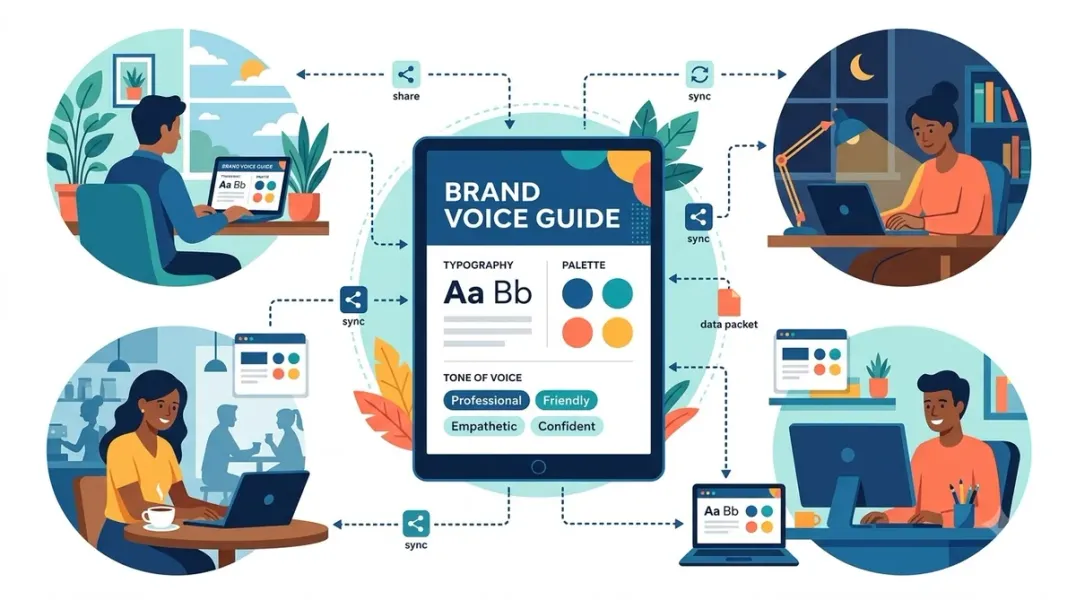
This guide walks you through creating a practical brand voice guide that keeps distributed teams aligned—without forcing every location to sound identical.
This distinction is foundational, and it matters most in local marketing.
Brand voice is your brand’s personality. It stays constant. It doesn’t change by city, channel, or audience. It answers “who are we?”
Brand tone is how that voice adapts to context. The same voice sounds different when responding to a five-star review versus a complaint, or when announcing a sale versus a hiring notice.
For distributed teams, this means: voice is defined by headquarters and non-negotiable. Tone is adapted by local teams within a framework set by headquarters.
Without this distinction, local teams either copy every corporate post verbatim (losing local relevance) or improvise freely (losing brand consistency).
Step 2: Define the Core Brand Personality
Brand voice must be translated into specific, actionable personality traits. Don’t say “our brand is friendly.” Define what “friendly” actually means in writing.
A practical framework for defining brand voice:
3–5 core personality traits. Each trait needs:
- A name (e.g., “Warm but not casual”)
- What it looks like in practice (with example sentences)
- What it doesn’t look like (the boundary)
A useful approach is the contrast framework. If your voice is “professional but approachable,” define both sides:
- What “professional” means: complete sentences, no slang, accurate information
- What “approachable” means: use “you” not “the customer,” allow moderate conversational phrasing
- How to balance: lean professional for formal updates, lean approachable for daily posts
Recommended voice traits for local marketing (as a starting point):
- Clear and direct: Google users want information, not poetry
- Trustworthy: local services carry high trust barriers; tone must convey reliability
- Helpful: every post should answer a question or offer a specific value
- Human: avoid corporate stiffness, but stay professional
Step 3: Build a Pass/Fail Example Library
Abstract tone descriptions don’t help distributed teams much. The most useful reference is concrete pass/fail examples.
Example library structure:
Scenario 1: Responding to a positive review
✅ On-brand (clear, warm, helpful): “Thank you for the feedback! We’re glad our service met your expectations. If you need [specific service] again, don’t hesitate to reach out.”
❌ Off-brand (too casual, lacks professionalism): “Awesome! Super thanks for the great review! Come back and we’ll hook you up!”
Scenario 2: Announcing an hours change
✅ On-brand (direct, complete information): “Update: Starting next Monday, our hours change to 8 AM–6 PM. Weekend hours remain the same.”
❌ Off-brand (vague, lacks specifics): “Hey everyone! Some changes coming! Stop by for details!”
Scenario 3: Publishing a promotional post
✅ On-brand (action-oriented, clear): “This week only: first-time visitors get 20% off. Tap below to book, or walk in and mention this offer.”
❌ Off-brand (fuzzy, no clear action): “Amazing deals incoming! Don’t miss out! Come experience it!”
Cover the scenarios your local teams encounter most: review replies, hours updates, promotional posts, Q&A responses, and event announcements.
Step 4: Define Localization Boundaries
This is the most critical and most overlooked part of a distributed team voice guide: what can change and what cannot.
Non-negotiable core (all locations must follow):
- Core brand personality traits
- Formality level (formal “you” vs. casual “you” in languages that distinguish)
- Prohibited language list (discriminatory terms, overpromising, unapproved pricing)
- Emoji rules (whether to use, frequency, appropriate contexts)
- Accuracy standards (hours, addresses, contact info must match official records)
Localization flexibility zone (adaptable by location):
- How local landmarks are referenced
- How community events are acknowledged
- Degree of humor and colloquialism (within headquarters’ limits)
- Cultural adaptation (without changing core personality)
A useful tool is a flexibility scale. For example:
| Dimension | Headquarters Range | Local Adjustment Space |
|---|---|---|
| Formality | Leans formal, complete sentences | Moderate colloquial phrasing allowed in everyday posts |
| Humor | Light, tasteful | Expression style may adapt to local culture, but no sarcasm or offensive humor |
| Emoji | Max 1–2 per post | May adjust by platform and content type, but never in negative review replies |
Step 5: Make the Guide Executable, Not Just Readable
A guide that’s readable but not executable is worthless to distributed teams. You need to make it referenceable at the moment of creation.
Embed into workflows. If your team uses approval tools (like n8n or a dedicated GBP management platform), build the tone check into the approval flow. Approvers reference a simplified “tone checklist” rather than re-reading the full guide.
Provide templates and frameworks. Don’t just say “write it this way.” Give teams post frameworks they can use directly. For example, a “local event announcement” template:
Headline: [Event name] takes place on [date] at [location] Body: [One sentence describing the event]. [Local detail]. Open to [target audience]. CTA: [Book / Learn more / Visit us]
The template preserves structural consistency; local teams fill in specifics.
Create a “quick reference card.” Condense the core voice traits and the most common pass/fail examples into one page for teams to keep open while writing.
Step 6: Build a Feedback and Iteration Loop
A voice guide isn’t a one-time document. Brands evolve, local markets shift, and new content scenarios emerge.
Recommended iteration rhythm:
- Quarterly review: Audit the past three months of content, identify tone drift, update the example library
- Local feedback loop: Regularly collect scenarios where local teams “didn’t know what tone to use” and add those scenarios to the guide
- New member onboarding: Make the voice guide a required part of local marketing onboarding, with a practical exercise (e.g., rewriting an off-brand post)
Conclusion
Creating a brand voice guide for distributed local marketing teams isn’t about writing a perfect document. It’s about building a system that’s referenceable, executable, and iterable.
The foundation is a clear separation between brand voice (fixed) and brand tone (adaptable). The core content is a set of concrete pass/fail examples so teams know what “sounds like us” and “doesn’t sound like us” actually look like. The operational key is defining localization boundaries—what can flex and what must stay fixed.
Most importantly, the guide must live inside your workflow, not in a folder. Templates, quick reference cards, and approval checklists are how distributed teams actually use a voice guide.
When every location’s Google Business Profile content reads like the same brand speaking in different places—rather than the same template copied across different cities—your voice guide has done its job.
Call to Action
Managing a distributed local marketing team? Download our Brand Voice Guide Template Pack—including a voice definition framework, pass/fail example templates, a localization flexibility scale, and a quick reference card you can adapt to your team structure.
FAQs
Q: What’s the difference between brand voice and brand tone? Brand voice is the brand’s personality—constant across contexts. Brand tone is how that voice adapts to different scenarios, audiences, and channels. In local marketing, voice is defined by headquarters; tone is adapted by local teams within a framework.
Q: How do I get local teams to actually use the voice guide instead of ignoring it? Embed it into workflows. Provide directly usable templates and frameworks, create a one-page quick reference card, and add a tone checklist to approval processes. Executability matters more than completeness.
Q: How much localization flexibility should teams have? Core personality, formality level, prohibited language, and emoji rules are non-negotiable. Local landmark references, community event tie-ins, and humor expression can adapt to local context—within headquarters-defined limits.
Q: Should Google Business Profile tone match social media tone? No. GBP users are actively searching. Tone should be more direct and action-oriented, focused on answering “when do you open, what do you offer, how much does it cost.” Social media tone can be more relaxed and brand-awareness focused.
Q: Do small businesses without a dedicated brand team need this guide? Yes, but it can be simplified. The core is 3 brand traits + a set of pass/fail examples + a prohibited language list. That’s enough to keep distributed local operators or agencies broadly aligned.
Internal & External Links
Internal Links
- [How to Manage Google Business Profile Content at Scale Without Duplicate Messaging]
- [How to Build a Google Business Profile Approval Workflow for Marketing Teams]
- [How to Create a Repeatable Quality Assurance Process for Local Listings]
External Sources
- Grammarly: Brand tones blueprint
- POEditor: How to build a brand voice and tone guide for localization teams
- Google Business Profile Community: Google Business Profile Posts Best Practices
Grow Your Google Maps Ranking on Autopilot
Stop spending hours every week manually replying to customer reviews and writing Google posts. Busirank automates your Google Business Profile to boost your local SEO rankings and turn searchers into paying clients.

 Busirank Team
