 Busirank Team
Introduction
Most small businesses treat review responses as an afterthought—a quick thank-you to happy customers, an awkward silence for unhappy ones. That is a costly mistake. Every review response is a public signal to Google, to future customers, and to AI systems that increasingly shape local search results.
The numbers tell the story. According to BrightLocal’s 2026 consumer survey, 93% of consumers read online reviews before choosing a local business, and 87% will not consider a business with fewer than 4 stars . Meanwhile, 97% of people who read reviews also look for business responses, and 88% are more likely to choose a business that replies to all reviews . Google itself has updated its guidance to emphasize that review replies should be helpful, human, and aligned with customer care values—not sales pitches .
For small businesses, this represents one of the highest-leverage, lowest-cost local SEO opportunities available. A thoughtful review response strategy does more than protect your reputation. It reinforces service relevance, signals geographic location, improves conversion rates, and feeds Google’s algorithm with the exact language customers use to describe your business.
This guide provides a complete, actionable framework for building a review response strategy that works for small businesses—whether you have one location or ten, whether you get five reviews a month or fifty.
Before diving into tactics, it is critical to understand what your review responses actually do in the context of local search.
Google uses review signals—quantity, velocity, rating, and response engagement—as ranking factors for the local Map Pack and Google Maps results . When you respond to a review, you create fresh, indexed content on your Google Business Profile that reinforces what your business does and where it does it. A response that mentions “roof repair” and “Boca Raton” tells Google that your business is relevant for those terms.
This is not keyword stuffing. It is echoing the customer’s own language back to them, which is exactly what search algorithms are trained to recognize as authenticity. Google’s algorithm picks up on service-relevant keywords in review responses, and repeating the customer’s specific phrasing signals that your business actually offers that thing .
Beyond SEO, responses drive conversion. A potential customer reading your reviews is not just evaluating the reviewer’s experience—they are evaluating how you handle feedback. A calm, professional response to a negative review often does more to build trust than ten positive reviews alone. Research shows that 45% of consumers are more likely to visit a business that responds to negative reviews .
The 5-Pillar Review Response Framework
A sustainable review response strategy rests on five pillars: monitoring, response speed, personalization, keyword integration, and escalation protocols. Each pillar supports the others, creating a system that runs consistently rather than relying on memory or mood .
Pillar 1: Monitoring
You cannot respond to what you do not see. Set up notifications across every platform where your business appears—Google Business Profile, Yelp, Facebook, industry directories, and any niche platforms relevant to your sector . Enable email alerts, check dashboards weekly, and consider using a review management tool if you are handling more than a few reviews per month.
Pillar 2: Response Speed
Speed signals attentiveness. The ideal response window is within 24 hours for positive reviews and within 6 to 12 hours for negative reviews . A one-star review answered the same day says “we are on it.” Answered in week three, it says “we finally noticed.” Google’s local algorithm also rewards active engagement, so rapid responses contribute to ranking signals.
Pillar 3: Personalization
Generic responses are worse than no response at all. Fifty percent of consumers say templated, copy-paste replies make them less likely to choose a business . Every response should include the reviewer’s name and at least one specific detail from their review. This proves you actually read it.
Pillar 4: Keyword Integration
This is where local SEO value compounds. When a customer mentions a specific service or location, echo that phrase naturally in your response. If someone writes “the emergency plumbing service was fast,” your reply should reference “emergency plumbing.” If they mention “your Dallas team,” your response should include “Dallas.” This reinforces relevance for local queries without crossing into spam territory .
Pillar 5: Escalation Protocols
Not every review deserves the same response. Establish clear escalation rules. A 3-star review mentioning a minor inconvenience gets a standard acknowledgment. A 1-star review alleging safety issues or staff misconduct gets immediate owner attention and an offline resolution path. Define who handles what, and when to take conversations private .
Response Templates by Star Rating
The following frameworks provide starting points. Every response should be personalized before posting.
5-Star Reviews: Warm and Specific
The goal is gratitude plus reinforcement. Thank the customer by name, reference something specific they praised, and invite them back or suggest a next step.
Framework: Thank by name + reference specific detail + reinforce your values or expertise + soft invitation.
Example: “Thank you, Marcus! We are glad the AC installation went smoothly and our team could work around your schedule. Keeping West Palm Beach homes cool is what we do. Do not hesitate to reach out when you are ready for that duct cleaning we discussed. Appreciate you trusting us with your home!”
4-Star Reviews: Acknowledge and Improve
Four stars means they liked you but something held them back. Acknowledge the feedback, show you heard it, and give them a reason to return.
Framework: Thanks + acknowledge the concern + show what you are doing about it + invitation to return.
Example: “So glad the food delivered, and fair point on Saturday night. We have been adjusting our kitchen flow for peak hours, and honestly, we are not quite where we want to be yet. Weeknights genuinely are a different, calmer world in here. If you do come back, try the Thursday special. Hope to see you again!”
3-Star Reviews: The Convertible Middle
Three-star reviewers are not angry—they are unconvinced. These are often the most convertible customers if you give them a reason to return. Avoid hollow corporate-speak or defensiveness.
Framework: Thank for honesty + validate their concern + brief context (not excuse) + specific invitation.
Example: “You are right. A promised delivery date is a promise, and we did not keep it. We have been dealing with a carrier issue we are actively sorting through, but that is context, not an excuse. If you are willing to give us another shot, reach out directly and mention this. I would like to make the next experience a lot better.”
2-Star and 1-Star Reviews: Own It, Move It Offline
The audience for your negative review response is not the unhappy reviewer—it is every future customer reading the exchange. Stay calm, acknowledge the experience, apologize for the dissatisfaction (not necessarily for being wrong), and provide a direct contact to resolve the issue .
Framework: Acknowledge + apologize for experience + take responsibility + provide direct contact + sign with a name.
Example: “Hi John, I am sorry to hear your experience did not meet expectations. That is not the standard we hold ourselves to. I would like to understand what happened and make this right. Please call me directly at [number] or email [email]. I am the owner and want to personally address this. – Mike”
The Keyword Integration Formula
Keyword integration in review responses follows a simple pattern: Name + Service + Location + Outcome .
When a customer leaves a review, identify the service they mentioned, the location (if they mentioned it), and the result or experience they described. Then craft a response that naturally weaves those elements together.
Customer review: “Great experience with this company.”
Weak response: “Thanks!”
Strong response: “Thanks for trusting us with your kitchen remodel in Temecula! We are glad you loved the results.”
The strong response mentions service (kitchen remodel), location (Temecula), and outcome (loved the results). Google reads those replies for keywords, and they strengthen local SEO for searches like “kitchen remodel Temecula” .
The key is naturalness. If it sounds like you are stuffing keywords, you are doing it wrong. Echo the customer’s own words. If they said “emergency plumbing,” you say “emergency plumbing.” If they said “your Dallas team,” you say “Dallas.”
Building a Sustainable Response Workflow
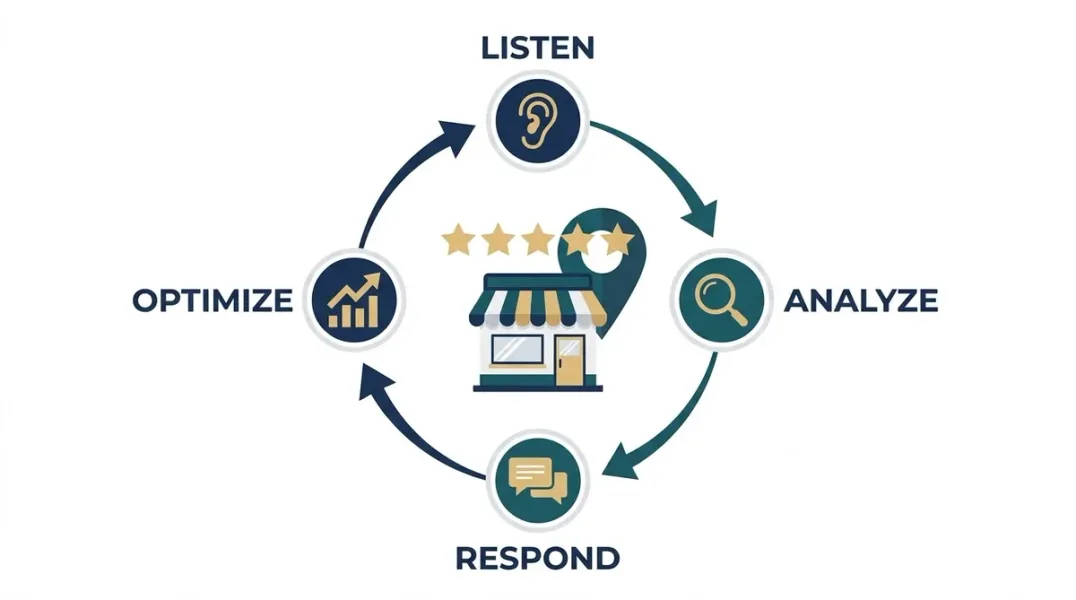
Consistency beats intensity. A small business that responds to every review within 24 hours for a year will outperform one that runs a frantic response marathon once a quarter.
Daily or Weekly Review Check
Set aside 10 minutes daily or 30 minutes weekly to clear new reviews. Check Google Business Profile first, then other platforms. Respond to all new reviews in one session.
Response Template Library
Create a shared document with response frameworks for each star rating and common scenarios: pricing complaints, wait time issues, staff praise, service-specific feedback. Templates provide structure, but always personalize before posting .
Team Roles
If you have staff, assign review response responsibility. A manager can handle standard responses; the owner handles escalated negative reviews. Provide training on tone and policy compliance .
Monthly Analysis
Once a month, review your responses for patterns. Are you consistently slow on weekends? Are certain complaints recurring? Use this analysis to improve both your response workflow and your underlying operations.
What NOT to Do: Policy and Compliance
Google actively polices review manipulation, and the FTC’s Consumer Reviews and Testimonials Rule, effective October 2024, turned several bad behaviors into enforceable violations .
Never incentivize reviews. Offering discounts or gifts in exchange for positive reviews violates Google’s policies and the FTC rule. You can thank customers for feedback, but the reward cannot be tied to the rating.
Never argue publicly. Your response is for the silent audience, not for winning an argument. Defensive replies signal to future customers that you are difficult to work with .
Never use copy-paste responses. Generic replies reduce trust. Personalize every response with the reviewer’s name and a detail from their review .
Never share private information. Do not reference order numbers, account details, or any personal data in public responses. Take those conversations offline .
The Business Case: What Response Consistency Delivers
A study in the Journal of the Academy of Marketing Science analyzed more than 150,000 reviews and responses, finding that customized replies to positive reviews produced the most reliable lift in future ratings and financial performance . Womply’s analysis of more than 200,000 small businesses found that those replying to at least 25% of reviews earned 35% more revenue than average .
Case study evidence supports the same conclusion. A multi-location automotive repair shop in Utah implemented a 24-to-48-hour response policy with location-specific replies and saw a 34% boost in local pack visibility, a 22% increase in calls from Google Maps, and a 44% jump in appearances in Google’s AI Overviews .
Conclusion
Review response strategy is not a nice-to-have for small businesses. It is a direct lever for local SEO rankings, conversion rates, and customer trust. The businesses that respond consistently—to every review, across every platform, with personalized and thoughtful replies—build a compounding advantage that competitors who ignore reviews cannot match.
The framework is straightforward: monitor all platforms, respond within 24 hours, personalize every reply, integrate keywords naturally, and escalate negative reviews with care. Templates provide starting points; personalization provides the power.
Start today. Open your Google Business Profile, find the most recent unreplied review, and write a response that proves a real human read it and cared enough to answer. Then make it a routine. The trust you build, one reply at a time, becomes your most durable local marketing asset.
Call to Action
Ready to turn your reviews into a local SEO engine? Start by auditing your last 20 reviews. Identify which ones still need responses. Use the frameworks in this guide to craft personalized replies, then implement a daily or weekly response routine.
Download our Review Response Template Library for ready-to-use scripts by star rating and scenario. Or contact our local SEO team to build a complete reputation management system for your business. Your next customer is reading your reviews right now—make sure they like what they see.
FAQs
How quickly should I respond to Google reviews?
Respond to positive reviews within 24 to 48 hours. Negative reviews require faster action—within 12 to 24 hours is ideal. Speed signals attentiveness and contributes to local ranking signals .
Should I respond to every review, including positive ones?
Yes. 88% of consumers are more likely to choose a business that replies to all reviews, positive and negative. Responding only to one type reduces trust .
Can I use templates for review responses?
Templates are fine as starting points, but they must be personalized. 50% of consumers say generic, copy-paste responses make them less likely to choose a business. Always add the reviewer’s name and a specific detail from their review .
How do I handle fake or malicious reviews?
If a review violates Google’s policies—spam, fake content, conflict of interest—flag it for removal. For suspected fakes that do not clearly violate policy, respond professionally, note that you cannot locate their record, and invite them to contact you directly .
What is the keyword integration formula for review responses?
Name + Service + Location + Outcome. Echo the customer’s own words naturally. If they mentioned “emergency plumbing” and “Dallas,” include those phrases in your reply. This reinforces local relevance without keyword stuffing .
Internal & External Links
Internal Links
- How Google Maps Reviews Influence Customer Buying Decisions (Topic 62)
- Google Business Profile Review Responses: What to Say in Different Situations (Topic 63)
- How to Get More Google Reviews Without Annoying Your Customers (Topic 64)
- How to Monitor Competitor Google Reviews and Find Market Opportunities (Topic 66)
External Sources
- Google Business Profile Help: Respond to Reviews: https://support.google.com/business/answer/3474050
- FTC Consumer Reviews and Testimonials Rule: https://www.ftc.gov/legal-library/browse/rules/consumer-reviews-testimonials
- BrightLocal Local Consumer Review Survey: https://www.brightlocal.com/research/local-consumer-review-survey/
- Google Search Central: Local Business Structured Data: https://developers.google.com/search/docs/appearance/structured-data/local-business
Grow Your Google Maps Ranking on Autopilot
Stop spending hours every week manually replying to customer reviews and writing Google posts. Busirank automates your Google Business Profile to boost your local SEO rankings and turn searchers into paying clients.

 Busirank Team
