 Busirank Team
Introduction
The debate over centralized versus decentralized local marketing is one of the most persistent tensions in franchise and multi-location business strategy. Corporate leadership argues for consistency, efficiency, and brand protection. Local operators argue for relevance, agility, and community connection. Both are right.
The challenge is not choosing one model over the other. It is understanding when each approach serves the business best—and building a structure that lets both coexist without constant friction.
This guide examines the three primary models, the data behind how budget actually flows, real-world outcomes from brands that got the balance wrong, and the framework for determining which structure fits your organization.
Centralized Marketing
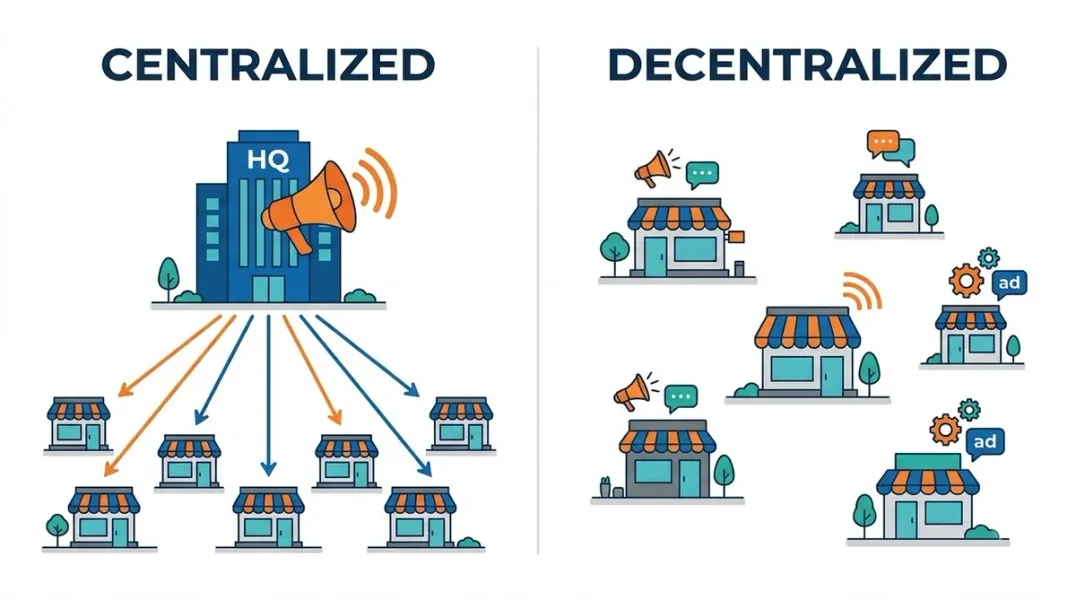
In a fully centralized model, the franchisor or corporate entity controls all marketing decisions, budgets, and execution. Local operators have little to no say in how marketing dollars are spent or what messages reach their markets .
This model excels at brand consistency. National campaigns deliver one coherent message, protect brand voice, and achieve media buying efficiency that individual locations cannot replicate .
The risk is distance from the customer. A campaign that resonates in one region may fall flat in another. When corporate messaging does not reflect local realities, franchisee engagement drops—and so does execution .
Decentralized Marketing
In a fully decentralized model, each franchisee or location manages its own marketing independently. They control the budget, choose the channels, and determine the messaging for their local market .
This model excels at community connection. A fitness brand that gave franchisees a “community playbook” saw locations using it bring in up to 25 percent more new members in their first year . Local operators know their customers, their competitors, and what resonates in their neighborhoods.
The risk is fragmentation. Without guardrails, each location builds its own mini-brand. Shared learning disappears, data becomes incomparable, and the consumer no longer recognizes the formula as one cohesive entity .
Hybrid Marketing (The Emerging Standard)
The hybrid model combines centralized strategy with controlled local flexibility. Corporate sets the brand framework, campaign direction, and measurement standards. Local operators execute within that framework, adding market-specific content and community engagement .
This is the model most successful systems are moving toward. Corporate acts as the director—building the stage and setting the rules—while local operators bring local flavor and authentic community connection .
The key distinction: localization should not mean allowing every location to develop its own disconnected strategy. Local flexibility operates within an agreed framework, using common decision rules and evidence to determine when execution should change .
The Budget Reality: 73/27
Understanding how budget actually flows between corporate and local is essential to evaluating which model you have—and whether it is working.
According to research from NP Digital, corporate entities control 73 percent of franchise marketing budgets, while local franchisees control only 27 percent .
This split has significant implications:
- Local marketers are under-resourced despite their proximity to customers.
- Corporate campaigns may dominate at the expense of local relevance.
- In-market responsiveness slows because local teams lack budget to test and iterate quickly.
- The 73/27 split may limit neighborhood-level ROI and personalization .
The research suggests that brands willing to shift even a portion of central spend to local teams unlock new growth opportunities in authenticity, engagement, and neighborhood-level ROI .
The Papa Johns Case: What Happens When You Get It Wrong
The debate over centralization versus decentralization is not theoretical. Papa Johns provides a cautionary case study.
In early 2025, the pizza chain introduced a strategy called “Back to Better 2.0” designed to lift sales out of post-pandemic doldrums. At its center was a shift in ad spending from local to national. Operators would contribute more to the national marketing fund in exchange for the ability to devote no funds to local marketing. The regional co-ops that managed local marketing dollars were eliminated .
The results were immediate and negative. Same-store sales declined 2 percent in the first quarter. After the new national campaign launched, declines accelerated: 4 percent, then 6 percent in the third quarter .
The new CEO called the decision “a big miss” at an investor conference. “We made local optional. All the co-ops went away. And not having the co-ops to be able to put the franchise community together in the communities that we serve, have the company sitting around the table is a big mess in a business that is a very regional business, especially pizza being so localized” .
Most franchisees stopped spending on local marketing, which ultimately ended the local co-ops. The company is now working to rebuild them, acknowledging that local marketing is essential to the business model .
The lesson: national marketing alone does not drive local sales. The “air cover” of brand awareness requires “ground assault” of local activation to convert demand into revenue .
The Air Cover and Ground Assault Framework
The most useful mental model for understanding the relationship between centralized and decentralized marketing comes from the franchise budget debate itself.
National brand spend provides air cover. It warms up the market, builds psychological familiarity, and establishes price authority. It creates the conditions for demand .
Localized ad spend provides ground assault. It targets specific zip codes to harvest high-intent demand and convert it into visits and purchases .
Run local ads with zero brand air cover, and your cost per lead skyrockets because the audience is cold. Run national ads with no local path to purchase, and you are paying for expensive digital billboards that do not drive action .
Neither works alone. The strongest systems use both—corporate for the big campaigns, franchisees for the grassroots work that only a local owner can do .
How to Choose: A Decision Framework
Which model fits your business depends on several factors.
Choose more centralization when:
- Your brand is new and needs to establish consistent recognition.
- Your franchisees lack marketing expertise or bandwidth.
- You operate in a category where brand trust drives purchase decisions (healthcare, financial services).
- Media buying efficiency is critical to your margins.
Choose more decentralization when:
- Your brand is established and recognized in your markets.
- Your franchisees are experienced operators with marketing capability.
- Your business is inherently local (restaurants, fitness, home services).
- Community connection and local authenticity drive customer acquisition.
Choose hybrid when:
- You want brand consistency without sacrificing local relevance.
- Your markets vary significantly in demographics and competition.
- You have the technology infrastructure to manage distributed execution.
- Your franchisees range from passive to highly engaged.
Most mature franchise systems will find that hybrid is the right answer. The question is not whether to centralize or decentralize, but how to design the framework that lets both operate effectively .
Building the Hybrid Framework
A successful hybrid model requires clear answers to three questions:
What does corporate own? Brand strategy, visual identity, national campaigns, the website platform, core technology, measurement standards, and the guardrails within which local execution happens .
What do local operators own? Market-specific content, community engagement, local sponsorships, promotional offers within approved frameworks, and customer relationship building .
How does budget flow? A defined split between brand fund contributions and local marketing obligations, with transparency about what each fund produces and how performance is measured .
The most effective systems also build in performance-based budget releases for franchisees who demonstrate effective execution. This creates a carrot for local compliance while maintaining corporate oversight .
Technology as the Enabler
The hybrid model depends on technology that makes distributed execution manageable. Modern franchise marketing platforms allow corporate to set brand AI that trains every local agent on voice and guidelines, with tiered approvals and location-level permissions .
Corporate can set agents to act autonomously within guardrails or require approval for specific content types. Local teams can add authentic local content without bottlenecks or compliance risk. The work happens whether or not the franchisee ever logs into the platform .
This technology layer is what makes the hybrid model scalable. Without it, corporate oversight becomes a bottleneck, and local execution becomes inconsistent.
Conclusion
The centralized versus decentralized debate is a false dichotomy. The strongest franchise and multi-location marketing systems use both: corporate for brand strategy, scale, and consistency; local for community connection, relevance, and agility.
The 73/27 budget split that currently exists in many systems may be limiting local growth. Brands that shift even a portion of central spend to local teams—with the right guardrails and measurement—unlock authenticity, engagement, and neighborhood-level ROI .
The Papa Johns case demonstrates the cost of getting the balance wrong. National marketing without local activation does not drive sales. The air cover needs ground assault to convert demand into revenue .
Your model should match your brand’s maturity, your franchisees’ capabilities, and your markets’ variability. For most, that means hybrid—a centralized framework that enables, rather than constrains, local execution.
Call to Action
Ready to assess your local marketing model? Download our Centralized vs Decentralized Decision Framework to evaluate your current structure, identify gaps, and design a hybrid approach that fits your business.
FAQs
Q: What is the typical budget split between corporate and local marketing in franchises? A: Corporate controls approximately 73% of franchise marketing budgets, while local franchisees control 27%. This split often limits local relevance and in-market responsiveness .
Q: Can a fully centralized marketing model work for franchises? A: It can work for brand consistency and efficiency, but it often fails on local relevance. The Papa Johns case showed that eliminating local marketing entirely led to declining sales and the collapse of regional co-ops .
Q: What is a hybrid marketing model for franchises? A: Corporate sets brand strategy, campaign frameworks, and measurement standards. Local operators execute within those guardrails, adding market-specific content and community engagement. Technology enables distributed execution with compliance oversight .
Q: How do I know if my franchise needs more centralization or decentralization? A: More centralization suits new brands or those where trust drives purchase. More decentralization suits established brands with capable local operators in inherently local categories. Most mature systems benefit from a hybrid approach .
Q: What are the risks of full decentralization? A: Each location builds its own mini-brand, shared learning disappears, data becomes incomparable, and consumers no longer recognize the brand as one cohesive entity .
Internal & External Links
Internal Links
- How to Build a Local Marketing Budget for a Franchise Network
- How to Create a Local Marketing Policy for Franchisees
- How to Measure Staff Productivity in Multi-Location Marketing Operations
External Sources
- NP Digital: How Do Franchises Split Marketing Spend https://neilpatel.com/marketing-stats/central-vs-local-franchise-spend/
- Restaurant Business: Papa Johns Local Marketing Miss https://www.restaurantbusinessonline.com/financing/papa-johns-moving-away-local-marketing-was-big-miss
- DAC Group: Connecting National Investment to Local Outcomes https://www.dacgroup.com/en-ca/insights/blog/paid-media/did-the-marketing-campaign-fail-or-did-the-local-network-fail-to-convert/
Grow Your Google Maps Ranking on Autopilot
Stop spending hours every week manually replying to customer reviews and writing Google posts. Busirank automates your Google Business Profile to boost your local SEO rankings and turn searchers into paying clients.

 Busirank Team
